The V2MOM framework - Vision, Values, Methods, Obstacles, and Measures - helps organizations set clear goals and align teams. At its core, Values guide decision-making and ensure alignment with an organization’s principles. Without them, even teams sharing the same vision may lack direction.
Here are six ways to define Values using V2MOM:
- Founder and Leadership Stories: Reflect on pivotal decisions and experiences to uncover values rooted in the company’s origins.
- Employee Input: Use surveys and focus groups to identify behaviors employees value and see rewarded.
- Customer and Stakeholder Feedback: Gather external insights to ensure values resonate beyond internal teams.
- Review Past Successes and Failures: Analyze key events to identify recurring behaviors that drive results or address challenges.
- Work Backward From Vision and Strategy: Tie values directly to long-term goals and required behaviors.
- Prioritize and Test Values: Refine and validate values through comparisons and real-world scenarios.
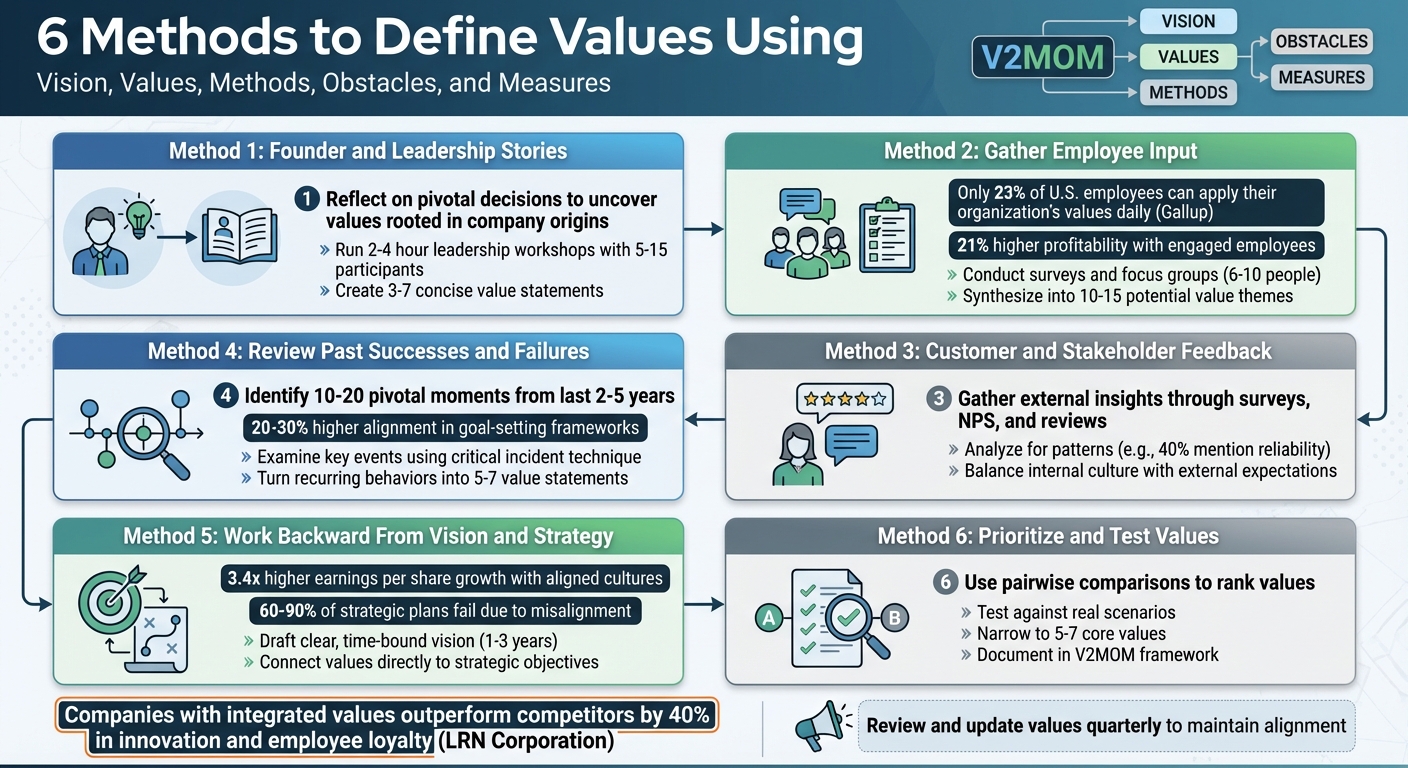
6 Methods to Define Values in V2MOM Framework
👉 “V2MOM Framework Explained | The Salesforce Strategy Behind 10x Company Growth 🚀”
Method 1: Use Founder and Leadership Stories
The origins of your company often hold the key to its core values. Founders and leadership teams make decisions rooted in their beliefs - whether it's choosing to prioritize customer trust during a challenging moment or empowering employees to lead with confidence. By reflecting on these stories, you can uncover the principles that align with your vision and establish a strong foundation for your values. This approach creates a seamless connection between leadership-driven ideals and actionable steps.
Take David Ciccarelli, CEO of Voices.com, as an example. He adopted the V2MOM framework because it begins with the founder's long-term vision and values. Voices.com embraced principles like employee empowerment and integrity, drawn directly from its founder’s experiences, which helped the company earn recognition as a top small business on local Best Place to Work lists [4][5]. Similarly, Salesforce founder Marc Benioff embedded values such as Trust, Customer Success, Innovation, and Equality early on, uniting over 70,000 employees and contributing to $34.9 billion in revenue for FY2024 [6].
Run Leadership Workshops
Host a 2–4 hour workshop with your leadership team, ideally in small groups of 5–15 participants. Start with storytelling sessions where each leader shares 2–3 pivotal experiences that shaped the company. As these stories unfold, listen for recurring themes - like integrity, transparency, or innovation - and use affinity mapping to group similar ideas. Once you've identified the themes, rank them based on how well they align with your company’s vision. This collaborative process mirrors Salesforce’s strategy, where executives work together to refine values into clear, memorable language.
Make sure everyone has an equal voice during the workshop, and focus on anchoring values in specific stories rather than abstract concepts like "hard work." In the V2MOM framework, values are meant to guide behavior, not function as rigid targets. These themes will serve as the foundation for crafting clear and actionable value statements.
Write Value Statements
Transform the themes into 3–7 concise and actionable value statements. Each statement should be motivational and directly linked to the behaviors highlighted in the leadership stories. For instance, instead of a generic phrase like "Employee empowerment", you could write:
"Employee empowerment: We trust our teams to make decisions aligned with our vision."
Test each statement against past successes to ensure it provides clear guidance. If a statement doesn’t resonate or fails to inspire action, revise it. These value statements act as your moral compass, connecting your vision to everyday decisions and ensuring all strategies align with your core principles. They also set the stage for the next steps in the V2MOM framework.
Method 2: Gather Employee Input
Employees are often the best observers of which behaviors are rewarded and which principles are overlooked in practice. By involving them in shaping your company's values, you create a framework that feels real and relevant - something they can actually use in their daily work. Let’s explore some practical ways to tap into these critical employee insights.
According to Gallup, only 23% of U.S. employees strongly agree they can apply their organization’s values to their work every day. Yet, companies with highly engaged employees - often tied to clear, relatable values - achieve 21% higher profitability and 59% lower turnover in high-turnover industries. The key isn’t just having values; it’s having values that employees helped define and can see reflected in their work.
Conduct Surveys and Focus Groups
To go beyond leadership perspectives, employee feedback is essential for uncovering how values are truly experienced on the ground. Start with a values survey featuring two types of questions.
- Descriptive questions like: “What three words best describe how things are done here?” or “Which behaviors are rewarded?” These help identify your organization’s current, lived values - not just the ones listed on your website.
- Prescriptive questions like: “What values should guide us as we grow?” or “What principles would help us achieve our vision?” These explore aspirations and future direction.
Using a mix of Likert scales and open-ended questions allows you to gather both measurable data and deeper employee insights.
Focus groups add context to survey results and bring values to life through real stories and examples. Include employees from diverse roles and backgrounds - frontline workers, middle management, remote staff, and underrepresented groups - to ensure balanced input. Instead of abstract questions, use real-world scenarios like: “Tell me about a tough decision your team made recently. What drove that choice?” or “When have you seen someone go above and beyond? What motivated them?” Keep groups small (6-10 people), use neutral facilitators, and establish psychological safety with rules like confidentiality and no attribution to encourage honest feedback.
Combine Employee and Leadership Views
Once you’ve gathered employee insights, the next step is to align them with leadership’s vision. Start by synthesizing the feedback into 10-15 potential value themes. Look for recurring words and ideas from surveys and focus groups - terms like “openness,” “candor,” and “transparency” might all point to a single core value.
Bring leadership together to evaluate these themes against three key criteria:
- Alignment with your long-term vision.
- Support for your strategic goals.
- Resonance with employee feedback, based on how frequently and strongly it was expressed.
When leadership priorities seem to clash with employee input - such as “speed” versus “quality” - facilitate discussions to create balanced formulations like “customer-first excellence” that honor both perspectives. Ultimately, select 4-7 core values that connect your strategy with your culture. Document the reasoning behind each selection.
Transparency is critical here. Share with employees how their feedback influenced the final values and explain any trade-offs. This builds trust and encourages future participation. These values can then form the foundation for defining your Methods and Measures within frameworks like V2MOM, ensuring they guide both strategy and action.
Method 3: Use Customer and Stakeholder Feedback
While internal insights lay the groundwork for defining your organization's values, external perspectives - those of your customers and stakeholders - add a whole new layer of refinement. These groups often view your organization through lenses that internal teams might overlook. They assess whether your promises build trust, if your actions are consistent, and how your principles create real-world impact. This external feedback ensures your values resonate not just within your team but also in the market. Together, internal and external insights create a balanced foundation for meaningful values.
Take Salesforce as an example. When customers and stakeholders began demanding stronger environmental responsibility, the company responded by weaving this feedback into their sustainability-focused V2MOM framework. They adopted values such as "prioritize sustainability" and "community dedication", which translated into actionable goals like achieving a 0% carbon footprint by 2030 and using 100% renewable energy by 2025. They didn’t stop there - they actively measure progress through energy consumption reductions and returns on green technology investments, cementing their leadership in corporate sustainability[9].
Turn Feedback Into Value Statements
Once you've gathered external feedback, the next step is turning it into actionable value statements. Start by collecting insights through customer surveys (like Net Promoter Scores), stakeholder focus groups, interviews, social media monitoring, and online reviews. These methods help you identify recurring themes that build trust and meet expectations.
After collecting feedback, analyze it for common patterns. For instance, if 40% of customer reviews highlight "reliability", or stakeholders frequently praise your "transparency", these themes deserve attention. Tools for thematic analysis or sentiment tracking can help sort and quantify responses. Focus on high-impact areas that align with themes like trust, innovation, or responsiveness.
Next, translate these patterns into clear, concise value statements. For example, if your customers emphasize fast problem resolution while partners value honest communication, you might create values like "Customer-first responsiveness" and "Open communication." These statements should connect directly to your long-term vision and be documented in your V2MOM framework, where they'll guide both strategy and decision-making.
Balance Internal and External Values
It’s not uncommon for external feedback to clash with internal culture. For example, employees might prioritize "innovation", while customers care more about "reliability." Or, stakeholders may want "thoroughness", while your team values "speed." These differences aren’t obstacles - they’re opportunities to create values that bridge both perspectives.
To address this, bring leadership together to compare internal values (derived from employee input) with external themes (from customer and stakeholder feedback). Start by identifying overlaps - areas where both groups align. For conflicting priorities, facilitate discussions to craft hybrid values that honor both viewpoints. For instance, if employees value innovation and customers prioritize dependability, a value like "reliable innovation" could strike the right balance.
Use the V2MOM framework to rank and prioritize values when trade-offs are necessary. Ask which values will have the greatest impact on your vision and which principles will guide critical decisions. Salesforce founder Marc Benioff captures this idea well, stating that values reflect "what’s important" and should be shaped by input from all sides - internal and external - to guide decision-making and build trust in dynamic environments[3][6][8].
Tools like V2MOM.io make this process seamless, enabling teams to collaborate in real time, rank values, and align them with both operational goals and external expectations.
Method 4: Review Past Successes and Failures
Your organization's history is a treasure trove of insights into what truly drives its values and actions. A structured method like the critical incident technique, developed by psychologist John Flanagan in the 1950s, can help uncover these insights. This approach focuses on analyzing specific events to identify the values that genuinely guide your organization - not just the ones you aspire to have[1][7].
Take Salesforce, for example. When the company faced challenges during rapid growth, it looked back at how transparent communication during tough times had consistently helped teams adapt. This reflection led to "transparency" becoming a core value that now shapes decision-making across the organization[6]. By examining key moments - both high points and setbacks - you can uncover the principles that drive success, tackle challenges, and align with your broader vision.
Examine Key Events
Start by assembling a diverse team to identify 10–20 pivotal moments from the last two to five years. These could include major successes, like a product launch that exceeded expectations, or failures, like a missed deadline that hurt client relationships. Think about moments where decisions had a significant impact - both good and bad[1][4].
Once you have your list, classify each event as a success or failure and dig into the details. For successes, ask what behaviors contributed to the outcome. Was it cross-department collaboration, clear communication, or a willingness to take calculated risks? For failures, pinpoint what went wrong. Did siloed information slow progress? Did a lack of diverse perspectives lead to poor decisions? Use interviews, project records, or timelines to gather insights. For instance, one tech company discovered that a major project delay was caused by teams hoarding information. This realization led to a new emphasis on inclusivity as a core value[1][3].
Look for recurring patterns. If you notice themes like quick adaptability during setbacks, innovation might be a key value. If open and honest communication stands out, integrity could be central. Organizations that use this reflective approach often report higher alignment - up to 20–30% - in goal-setting frameworks like V2MOM. This is because values rooted in real behaviors resonate more deeply than abstract ideals[6].
Turn Behaviors Into Values
Once you've identified these patterns, translate them into clear, actionable value statements. Just like insights from leadership stories and employee feedback, these historical behaviors should align with your vision and strategy.
Start by identifying the core principle behind the behavior. For example, if your team consistently shared information across departments during crises, the underlying value might be "collaboration" or "transparency." Next, phrase it as a guiding principle. Instead of something vague like "be nice", write: "We practice transparency in all communications to build trust and make informed decisions."[2][3] Finally, tie each value directly to your V2MOM vision. If your goal is market leadership, a value like "We embrace innovation by questioning the status quo" shows how behavior supports strategy.
Keep your list concise - five to seven values is ideal. Test each one by mapping it back to the original incidents. Does "integrity" reflect the candid communication you observed? Does "inclusivity" address the siloed decision-making that caused past issues?[4][5]
Leadership plays a crucial role here. Facilitate workshops, validate these values against your vision, and model openness by sharing lessons from failures. As David Ciccarelli of Voices pointed out, when values are championed by founders and leaders, they set behavioral norms that ripple through the organization[4]. These values should then feed into your methods and measures, creating a continuous feedback loop. Quarterly reviews can test them against new incidents, refining them as your organization grows and evolves[6][7].
sbb-itb-ee93501
Method 5: Work Backward From Vision and Strategy
Many organizations make the mistake of defining vague values before crafting a clear strategy. A better approach is to work backward from your Vision and strategic objectives to identify the core values that truly matter. This method ensures your values are tightly connected to your goals and influence everyday actions.
Marc Benioff describes the V2MOM framework as "a detailed map of where we are going and an understanding of how to get there." It’s built around five critical questions: what you want to achieve, what’s important, how you’ll get there, what obstacles stand in your way, and how you’ll measure success[6]. By starting with your Vision, you ensure every value answers this key question: "What must be non-negotiable in how we work to make this Vision a reality?"
This approach results in values that directly support your strategic goals and guide decision-making. Research shows that companies with cultures aligned to their strategy experience 3.4 times higher earnings per share growth compared to those with poor alignment. Yet, 60–90% of strategic plans fail to materialize, often because day-to-day behaviors don’t reflect the stated strategy.
Connect Values to Goals
To make your values actionable, tie them directly to your strategic objectives. Start by drafting a clear, time-bound Vision for the next one to three years. Use straightforward language that anyone in your organization can understand. For example: "Become the leading SMB marketing automation platform in North America" or "Deliver the safest, most patient-centered care in our state"[4][9][6].
Then, outline the strategic objectives needed to achieve that Vision. For a SaaS startup, these might include rapid product updates, strong customer retention, and steady ARR growth. For a regional healthcare provider, objectives could focus on reducing readmissions, improving patient satisfaction scores, and ensuring regulatory compliance[2][7].
For each objective, identify the critical behaviors required to succeed and group them into themes that can be distilled into concise value statements. For instance:
- A SaaS company might develop values like "Ship to Learn", "Talk to Customers Weekly", and "Own the Quality."
- A healthcare provider might prioritize values such as "Safety First, Always", "Whole-Family Care", and "Stop the Line for Patients"[1][2][5].
Document these connections in a simple format: Goal → Required Behaviors → Value Name. Embed these values into existing processes like performance reviews, hiring criteria, promotion decisions, and planning frameworks. For example, if a sales goal ties into a value like "Customer Trust", make ethical selling practices a measurable factor in performance evaluations and training sessions[2][6].
Make Values Drive Execution
Once your values are aligned with your strategic goals, the next step is ensuring they drive daily operations. The real test is whether these values actively shape decisions and actions, rather than becoming a forgotten list on a poster. Integrate values into every stage of the V2MOM process and your core management routines.
In the Methods section, require every strategic initiative to specify the values that will guide its execution. For example, a "U.S. market expansion" plan should outline how the value "Customer-First" will be applied - such as adjusting local support hours, setting SLAs for U.S. time zones, or tailoring training programs[1][2][7].
In the Obstacles section, include cultural challenges like "low psychological safety across teams" if these barriers hinder people from living the values[6][7]. For Measures, track both outcomes (e.g., revenue, customer satisfaction scores) and behavioral indicators (e.g., the percentage of one-on-ones that discuss values, or the number of cross-team retrospectives held each quarter).
Test the relevance of each value by asking if it’s essential to achieving your Vision. Keep only the values that pass this test, so you’re left with a focused set of cultural drivers rather than a long list of generic ideals[4][5]. Use scenario testing to refine your values: consider real or hypothetical strategic dilemmas and ask, "If these are our values, what decision would we make?" Drop or revise any values that don’t consistently guide the right choices[6][5][7].
Leverage tools like V2MOM.io to visually connect and track these values throughout execution[1][2]. When values are seamlessly woven into planning, execution, and measurement, they become practical tools for achieving your Vision - not just empty words on a wall.
Method 6: Prioritize and Test Values
Once you've gathered a list of potential values, the next step is to refine and test them to create a focused and actionable set. It’s common to start with a long list of candidate values, but narrowing them down to those that truly influence behavior is key. Marc Benioff, the creator of Salesforce's V2MOM framework, suggests using pairwise comparisons - a method where you compare two values at a time, such as integrity versus innovation, to clarify priorities. This approach prevents overloading your organization with too many competing values and keeps the focus sharp [6].
Start by listing your candidate values and ranking them through pairwise comparisons. Pose questions to your leadership team like, “If we could only keep one, would it be transparency or speed?” Repeat this process until you’ve identified the top five to seven values. Salesforce’s practice of condensing its V2MOM framework onto a single page reflects the importance of prioritization [6].
Test Values Against Real Scenarios
To ensure your values hold up in real-world situations, test them using actual or hypothetical scenarios your organization might face. For example:
-
Scenario 1: Should a product ship on time despite a known bug, or should the release be delayed to ensure quality?
This tests the balance between customer success and speed to market. -
Scenario 2: Should the company walk away from a lucrative deal if the prospect violates its ethical standards?
This challenges the importance of integrity over revenue [1][6].
For each scenario, ask yourself: Does this value provide clear guidance on what to do? Would employees at all levels understand how to act based on these values? If a value doesn’t consistently lead to the right decisions across different scenarios, it might need to be revised or removed. For instance, testing innovation might involve seeing if it inspires teams to take calculated risks under tight deadlines without encouraging recklessness. Similarly, testing inclusivity in hiring conflicts could determine whether it prompts the team to prioritize diversity when qualifications are equal, ensuring fairness without compromising standards [1].
Gather feedback through workshops or surveys, scoring each value on its ability to guide decisions, align with the company’s vision, and gain buy-in from employees. Narrow the list to five to seven values, eliminating any that fail to provide clear guidance in more than 30% of scenarios. It’s also critical to ensure that no strategic goal requires behavior that contradicts a stated value - if it does, either the goal or the value needs to be reevaluated [1][6].
Finalize and Document Values
Once you've tested and refined your values, consolidate them into a final list that’s both actionable and easy to understand. Document these values in the Values section of your V2MOM framework. For each value, include a short label (e.g., “Customer Success First”), a brief explanation, and a real-world example that illustrates how it applies. For instance:
Integrity: “We disclose all risks in client proposals, as demonstrated during our Q3 budget discussions” [1][6].
Make these values accessible to everyone in the organization by sharing them through internal platforms like company intranets or tools such as V2MOM.io. These platforms not only centralize documentation but also support team collaboration for scenario testing and provide insights to ensure your values align with strategic goals. V2MOM.io even offers scalable plans tailored to businesses of various sizes.
During regular reviews - whether quarterly or annually - ask questions like, “Which values were the hardest to uphold?” and “Where did we have to make trade-offs between values?” This ongoing evaluation ensures your values stay relevant and continue to guide the behaviors needed to achieve your organization’s vision. By prioritizing, testing, and documenting your values, you turn them into practical tools that drive meaningful decision-making.
Integrate Values Into the V2MOM Cycle
Once you've defined and tested your values, the next step is weaving them into the V2MOM cycle to ensure they influence every decision. Values only come to life when they guide your Methods, Obstacles, and Measures.
For instance, if "innovation" is a core value, your Methods might include organizing quarterly hackathons to develop new ideas. If "transparency" is key, you could implement practices like publishing monthly progress reports accessible to all employees. This approach transforms values from abstract ideals into actionable strategies.
In the Obstacles section, identify challenges that could compromise your values. For example, the pressure to cut corners might threaten integrity, or employee fatigue could clash with a commitment to sustainable work practices. Create plans to address these risks. If burnout is a concern, you might mandate a cool-down period before major project launches to prioritize well-being.
Track both the results and how well the team adheres to values. For "inclusion", measure employee engagement; for "integrity", monitor ethics compliance. Research from LRN Corporation shows that companies with integrated values outperform competitors by 40% in areas like innovation and employee loyalty. Yet, according to Gallup, only 23% of U.S. employees strongly agree that they can apply their organization's values to their daily work. This gap highlights the importance of embedding values into operations rather than merely displaying them as slogans.
Apply Values in Daily Operations
Bringing values into everyday decisions - like hiring, performance reviews, and strategic choices - is essential. For hiring, embed values into job descriptions and interview questions. If "employee empowerment" is a priority, ask candidates behavioral questions such as, "Can you share an example of a time you took initiative without supervision?" Adding a "values alignment" column to hiring scorecards can help ensure new hires are in sync with your V2MOM's Methods.
When it comes to performance reviews, allocate 20–30% of the evaluation to values-based criteria. Assess behaviors like transparency in reporting issues, linking specific examples to the Methods employees used and the obstacles they faced. Using the V2MOM framework for reviews ensures discussions focus not only on achieving results but also on how values were upheld during challenges. This approach fosters trust and accountability across teams.
For strategic decisions, create simple value-based filters. Before approving a supplier contract, ask questions like, "Does this choice maintain customer trust? Is it fair?" Encourage leaders to reference these filters when making decisions and document any trade-offs where short-term benefits might conflict with core values. For example, Salesforce uses its V2MOM framework to prioritize suppliers that align with values like integrity, even if it means higher costs.
Review and Update Values
After embedding values into daily operations, it's important to periodically evaluate and refine them to stay aligned with your organization’s goals. Values should be dynamic and adaptable. Consider quarterly reviews to address evolving priorities, while annual deep dives can focus on market shifts, company growth, or strategic changes. Use a structured agenda for these reviews: What worked well? Where were values tested? Did any measures unintentionally encourage the wrong behaviors? What adjustments are needed for the next cycle?
Testing values against real-world scenarios is also crucial. For example, ask, "Did our response to a product failure reflect transparency?" Gather feedback through surveys or workshops, and track metrics related to values alongside revenue and productivity to emphasize their importance.
Tools like V2MOM.io can simplify this process by centralizing team engagement data, tracking V2MOM updates, and offering insights to identify alignment issues. With free plans for up to 10 users and pricing starting at $5.99 per user per month (billed annually) for larger teams, platforms like these make it easier for businesses of all sizes to prioritize values integration in a sustainable way.
Conclusion
The V2MOM framework is more than just a planning tool - it’s a structured approach that brings together stakeholders to transform abstract ideas into clear, actionable principles. By leveraging six key methods - founder stories, employee input, customer feedback, historical review, vision-workback, and rigorous testing - it turns values into practical guides for decision-making, helping teams tackle challenges and achieve measurable results.
As Marc Benioff envisioned, V2MOM answers five straightforward questions, with values addressing the critical "what's important to you?" This clarity turns values into what David Ciccarelli, CEO of Voices, describes as a "North Star" for decisions. These values not only set behavioral norms but also foster accountability and focus. When values connect your vision and methods, they create the alignment that helped Salesforce thrive during its rapid growth, uniting teams under a shared purpose. This framework ensures that decisions remain consistent and aligned with your strategic goals.
To make these values stick, strong support systems are essential. Without centralization, values can lose their impact or drift apart. This is where platforms like V2MOM.io come into play. By centralizing your framework, the platform provides real-time insights to highlight where values succeed or fall short. Its AI tools help refine how values are expressed across teams, ensuring consistency. With free and affordable plans, it makes alignment accessible for organizations of all sizes. Plus, the platform’s interactive organizational chart links individual V2MOM goals to specific roles and reporting lines, creating seamless alignment from leadership to frontline employees.
When values are aligned and continuously refined, they become the driving force behind every decision, advancing your strategic vision. By combining these six methods with tools that encourage collaboration and transparency, you ensure that values remain the cornerstone of your organization’s operations - quarter after quarter, year after year.
FAQs
How does the V2MOM framework help align organizational vision and values?
The V2MOM framework offers a clear and structured way to align an organization’s vision with its core values. By breaking down the vision into actionable steps and connecting them to foundational principles, it ensures that efforts remain consistent and purposeful.
Using features like collaborative goal-setting and progress tracking, the framework promotes transparency and accountability across teams. This shared clarity helps organizations focus on their priorities and maintain a strategic direction.
How does feedback from employees and customers help shape organizational values?
Feedback from employees and customers is crucial in defining and refining organizational values. Employees bring valuable insights into the company culture and internal dynamics, while customers shed light on how well your values resonate with their expectations and experiences.
By actively incorporating this feedback, you ensure your values reflect what genuinely matters to both groups. This not only strengthens trust and engagement but also deepens the bond between your organization and its stakeholders.
What are the best ways to test and prioritize organizational values?
Organizations can test and refine their core values by leveraging tools that monitor real-time progress and assess team engagement. Features like interactive dashboards and detailed metrics can reveal where alignment might be falling short and point out areas that need attention.
By diving into data-driven insights, businesses can fine-tune their strategies and concentrate on values that directly contribute to their broader objectives. Adding AI-powered recommendations into the mix can simplify decision-making, helping ensure that values are well-defined and aligned with the organization’s long-term vision.