95% of employees don’t understand their company’s direction. That’s a problem. Misaligned KPIs (Key Performance Indicators) waste time, create confusion, and derail progress. The solution? Tie every KPI directly to your company’s vision, mission, and values.
Companies like Zappos, Patagonia, and Google thrive by aligning metrics with what matters most - whether it’s customer happiness, sustainability, or fostering innovation. The result? Up to 33% higher employee engagement, better decision-making, and stronger collaboration across teams.
Here’s how to make it happen:
- Start with clarity: Define your vision (long-term goal), mission (how you’ll get there), and core values (what you stand for).
- Set SMART goals: Specific, Measurable, Achievable, Relevant, and Time-bound objectives.
- Pick the right KPIs: Focus on metrics that align with your goals and drive meaningful outcomes.
- Balance indicators: Use both leading (predictive) and lagging (historical) metrics to track progress.
- Cascade KPIs: Break down company-wide goals into actionable targets for each department and individual.
- Review and refine: Regularly assess KPI performance and adjust as needed.
When KPIs reflect your company’s vision, they serve as more than just numbers - they become a roadmap that unites teams, sharpens focus, and drives measurable success.
Mission, Vision, Strategy & KPIs: How It Actually Works
Building the Foundation: Vision, Mission, and Core Values
Before tying KPIs to your strategic goals, you need to establish a solid foundation. Think of your vision, mission, and core values as the blueprint of your organization. Without these clearly defined, KPIs risk becoming just numbers without any real impact. This foundation shapes who you are as a company, how you operate, and how you're perceived in the marketplace[2]. It’s this groundwork that guides the selection of KPIs that truly drive progress.
This isn’t just a theory. Take LinkedIn, for example. By embracing transparency and collaboration as core values, they built KPIs around regular feedback and team-based performance metrics. The result? A 40% boost in employee productivity and stronger team cohesion[3]. Their success stemmed from aligning metrics with a clear foundation.
Clarifying Your Organization's Vision
Your vision is essentially the future you’re striving to create. It’s the long-term framework that influences every strategic decision and action[2]. A strong vision answers the question: What does success look like in five or ten years?
Specificity is key. Instead of vague goals like "be the best", a compelling vision paints a clear picture. For example, if your vision is to become "the most customer-centric technology provider in North America", your KPIs would naturally focus on customer satisfaction, retention, and experience metrics - not just operational efficiency. The vision acts as a filter, helping you prioritize metrics that matter.
Without a clear vision, teams risk chasing metrics that don’t align with a unified goal. A well-defined vision ensures every KPI supports the broader direction, creating alignment across the organization.
Writing a Purpose-Driven Mission Statement
If the vision is your destination, the mission is how you plan to get there. A mission translates your aspirations into actionable steps and measurable outcomes. It bridges the gap between the abstract and the tangible - it’s your company’s reason for existing.
A strong mission statement should be specific enough to guide decisions. For instance, if your mission is "to empower small businesses with affordable financial management tools", your KPIs might include user adoption rates, Net Promoter Score, and customer retention. These metrics directly measure whether you’re delivering on your mission.
Using the SMART framework - Specific, Measurable, Achievable, Relevant, and Time-bound - ensures your mission drives practical action[2][4]. KPIs should directly support the mission’s objectives, turning inspiring words into measurable progress[2].
Identifying Core Values for Decision-Making
Core values are the beliefs that define your organization’s culture and guide employee behavior to achieve business goals[3][6]. They reflect what your company stands for and how it operates - not lofty ideals that don’t match reality[2].
When KPIs align with core values, they unify teams under a shared purpose, creating a stronger and more cohesive organization[2]. However, when there’s a disconnect between values and actions, it can lead to distrust and disengagement among employees and customers[9].
Consider the case of Tech Innovations. Despite rapid growth, they faced declining employee engagement because their operations didn’t reflect their stated values of integrity and innovation[9]. By weaving these values into performance metrics and evaluation criteria, they improved customer satisfaction significantly[9].
To avoid such misalignment, involve leadership and employees in identifying authentic core values. Then, use these values as a guide. Every KPI should connect to at least one of your core principles[2].
For example, if "integrity" is a core value, but you set a KPI that focuses solely on increasing sales without ethical considerations, you risk undermining your culture. Instead, if "sustainability" is a value, your KPIs might include metrics like reducing your carbon footprint or minimizing waste alongside financial goals. This approach ensures performance metrics reinforce your values rather than contradict them.
Patagonia exemplifies this perfectly. Known for its environmental commitment, the company measures KPIs that highlight sustainable practices, such as the percentage of recycled materials in products and carbon footprint reduction[3]. Their metrics reflect their values, turning their mission into measurable outcomes.
The clarity of your vision, mission, and values determines whether your KPIs will drive meaningful progress or just generate data. When these elements are well-defined and embraced by leadership, they provide the framework for selecting metrics that matter - metrics that tell the story of where your organization is headed and how it plans to get there. With this foundation in place, KPIs can be tailored to reflect and reinforce these core principles.
Converting Vision into Goals and Objectives
Once you’ve established your vision, mission, and values, the next step is turning that vision into actionable goals. A vision without clear objectives is just wishful thinking - it needs to be broken into specific, measurable steps that guide daily operations and connect your long-term aspirations with practical progress. This process helps bridge where you are today with where you aim to be. While your vision defines the ultimate destination, clearly defined milestones ensure you can measure progress and keep everyone on track.
Creating SMART Goals
The SMART framework - Specific, Measurable, Achievable, Relevant, and Time-bound - is a proven way to turn broad vision statements into practical, trackable objectives[4]. For instance, instead of a vague goal like "improve customer satisfaction", a SMART objective could be "increase enterprise customer retention rate by 25% within a year." Similarly, replace "boost sales performance" with something like "generate $2,000,000 in new business revenue by the end of Q4." Goals should stretch your team but remain realistic; for example, instead of "dominate global markets", aim for "expand into three new regional markets within 12 months." Adding time-bound parameters creates a sense of urgency and accountability.
Take the example of an e-commerce company aiming to enhance user experience. They identified "Time to First Byte" (TTFB) as a critical performance metric and set a SMART goal to reduce TTFB by 30% within six months. By improving website load times, they significantly boosted user satisfaction, which led to more returning customers and higher sales[5].
Prioritizing Objectives by Impact
Not all goals carry the same weight. Prioritizing objectives based on their impact ensures your organization focuses resources on initiatives that drive the most progress toward your vision. Start by identifying which objectives will make the biggest difference in achieving your mission. Let your core values guide this process - prioritize goals that align with your values and strategic intent. For example, if sustainability is central to your vision, focus on goals that reduce environmental impact rather than those solely aimed at cutting costs.
Research shows that companies with well-aligned KPIs and goals experience up to 33% higher employee engagement, with Intel reporting a 25% productivity boost from such alignment[3].
When prioritizing, balance short-term wins with long-term strategic value. A structured framework can help connect immediate objectives to your overarching vision:
- Vision: Your ultimate aspiration.
- Mission: A concrete goal achievable within 18–24 months.
- Principles: Guidelines for decision-making.
- Values: Core behaviors and cultural norms.
- Strategy: The roadmap for achieving the vision.
- Objectives and KPIs: Measurable targets that track progress.
For example, a startup specializing in mobile phone holders might aim to become a global leader in automotive accessories. They could set a mission to capture 5% of the U.S. market within 18–24 months and establish quarterly goals to build toward that mission[8].
Ask yourself: What story should your data tell? Review objectives quarterly or semi-annually to ensure they remain aligned with your vision. While mission statements are typically designed to last 18–24 months, they should be reassessed when market conditions, competitive pressures, regulatory changes, or financial shifts occur[8]. The challenge is distinguishing between frequent tactical adjustments and rare strategic shifts - especially when studies show that 95% of employees often lack clarity on their company’s direction[4].
Selecting and Aligning Key Performance Indicators
With your SMART goals established, the next step is choosing the right metrics to track progress. The key is to measure what truly matters.
Defining Relevant KPIs
Relevant KPIs are directly tied to your organizational goals and provide a clear picture of progress toward your vision. While vanity metrics might look good in reports, they offer little value in driving meaningful outcomes[4]. Teams tend to focus on what’s being measured, so tracking the wrong metrics can lead your organization astray.
Take website traffic, for example. Seeing a steady rise in total visits might seem like growth, but if those visitors aren’t converting into customers or taking meaningful actions, it’s just a superficial number. Instead, prioritize metrics like conversion rates or customer acquisition costs - these directly impact your business goals and reveal whether your efforts are paying off.
To identify meaningful KPIs, evaluate potential metrics based on three key criteria: relevance (does it align with a strategic goal?), measurability (can it be consistently quantified?), and actionability (can teams influence it through their work?)[10]. If a metric doesn’t meet all three, it’s probably not worth tracking.
Focus on metrics that translate your vision into measurable progress. This ensures your goals aren't just abstract ideas but actionable targets.
Avoid tracking too many metrics at once. Trying to monitor dozens of measurements can overwhelm teams and dilute focus[10]. Instead, aim for a streamlined approach - typically 3-5 KPIs per department that directly tie into company-level objectives[10]. Research shows that companies with well-aligned KPIs see up to 33% higher employee engagement, as employees can concentrate on what truly matters rather than juggling conflicting priorities[3].
Balancing Leading and Lagging Indicators
A well-rounded KPI strategy includes both leading and lagging indicators[3]. Lagging indicators reflect past performance - such as revenue, customer satisfaction scores, or employee retention rates - and show whether goals were achieved. Leading indicators, on the other hand, predict future outcomes and allow you to make adjustments before results are locked in. For example, if customer retention is your lagging indicator, leading indicators might include metrics like customer engagement rates or support ticket resolution times. These give you insight into whether customers are likely to stay.
Think of lagging indicators as a rearview mirror - they show where you’ve been. Leading indicators are like looking through the windshield - they help you anticipate what’s ahead and adjust your course. Both perspectives are essential for effective decision-making.
By combining these two types of indicators, you can both assess past performance and take proactive steps for the future. For instance, if customer engagement scores (a leading indicator) drop in March, you can implement retention strategies before that decline translates into higher churn rates (a lagging indicator) by June.
Aligning these indicators with your strategic objectives ensures that every metric drives meaningful outcomes.
Examples of KPI-to-Goal Alignment
Once you’ve identified relevant and balanced KPIs, the next step is aligning them with specific goals. This means pairing each metric with a strategic objective to ensure every measurement supports a broader purpose. Here’s how that looks in practice:
If your goal is to increase customer lifetime value by 20%, different departments can align their KPIs to contribute to this objective. For example:
- Marketing might focus on improving the Customer Engagement Rate by 15%.
- Sales could target a 25% increase in the Existing Customer Upsell Rate.
- Customer Service might aim for a 10% reduction in the Churn Rate[4].
For a customer satisfaction goal, the Net Promoter Score (NPS) is a key KPI. It measures how likely customers are to recommend your company, directly linking to satisfaction objectives[4]. Other useful metrics include customer retention rates, satisfaction scores, and lifetime value[3]. These differ from operational KPIs like process cycle time or cost per unit, which focus on internal processes rather than customer outcomes[4].
Companies like Zappos and Patagonia have shown how aligning KPIs across departments ensures everyone is working toward the same overarching goals[3].
When departments have overlapping responsibilities, shared KPIs encourage collaboration and accountability[4]. For instance:
- Marketing and Sales might jointly track lead quality scores or MQL-to-SQL conversion rates with a target of 25% improvement.
- Sales and Operations could collaborate on reducing customer implementation time by 30%.
- Operations and Marketing might share a goal of increasing the Customer Feedback Score by 15%[4].
This cross-functional alignment prevents siloed efforts and ensures teams are working together toward shared outcomes. Organizations that use aligned KPIs see efficiency gains of 15-30% in projects[4] and adapt to market changes 56% faster[4]. By aligning KPIs, you ensure the entire organization moves forward as one.
sbb-itb-ee93501
Implementing KPIs Across the Organization
Defining KPIs is just the beginning. The real challenge lies in making them part of the organization's daily rhythm. It's crucial that everyone - from executives to front-line employees - understands not only what to measure but why it matters and how their work contributes to the company’s success.
Once you've identified the right KPIs, the next step is embedding them across the organization to ensure every task aligns with the broader strategic vision. This involves translating company-wide goals into actionable metrics for each department and individual. When done effectively, this process creates alignment, where everyday actions directly support long-term objectives.
Cascading KPIs to Departments
Cascading KPIs means breaking down overarching company goals into specific, actionable targets for departments and individuals[3][4][7]. It’s about translating the big picture into clear objectives that every team can influence.
This starts at the top. Begin with the company’s strategic goals, then work downward. At every level, ask: What does this department or individual need to achieve to support the goal above them? This ensures roles are clear and resources are allocated effectively[7].
For example, if the company’s goal is to expand into three new markets, this objective trickles down. A regional director may take on the KPI of "Establish operations in one new market by Q3 2025." From there, a sales manager might focus on "Generate $500,000 in new revenue from the new market by Q3 2025"[4]. At each level, the goals become more specific, but they remain tied to the original strategy.
Cascading KPIs work especially well when departments share responsibilities. In these cases, shared KPIs encourage collaboration and reduce silos[4]:
| Department Combination | Shared KPI Example | Target Impact |
|---|---|---|
| Marketing + Sales | MQL to SQL Conversion | 25% improvement |
| Sales + Operations | Customer Implementation Time | 30% reduction |
| Operations + Marketing | Customer Feedback Score | 15% increase |
Take Marketing and Sales, for instance. When both track lead quality and conversion rates, they’re equally invested in the outcome. Marketing can’t just pass off poor-quality leads; they’re accountable for how those leads perform throughout the sales process.
Departmental ownership is critical for KPI success[4][7]. When each team owns metrics aligned with their function, they’re more invested in achieving them. For example, Sales might focus on pipeline growth and closed deals, Customer Success on retention rates, and Product on user adoption. This structure gives teams the autonomy to make decisions that drive results while ensuring everyone contributes to the company’s overall success.
Organizations that use this cascading approach often see measurable improvements. Companies with well-aligned KPIs report project efficiency gains of 15-30% and adapt to market changes 56% faster[4]. In 2023, Intel saw a 25% productivity boost after aligning KPIs with their evolving corporate goals and involving leadership in the process[3].
That said, avoid the pitfall of overloading teams with too many metrics. Stick to 3-5 KPIs per department, focusing on those that directly tie to company objectives. Too many metrics dilute focus, making it harder for teams to prioritize what truly matters.
Creating a Line of Sight for Employees
Creating a line of sight means connecting daily work to organizational outcomes in a clear, visible way[7]. Every employee should be able to answer: How does my work contribute to the company’s success?
Without this clarity, even the most motivated employees may struggle to prioritize tasks or make decisions that align with strategic goals. A strong line of sight begins with clear communication about how departmental KPIs support broader objectives and how individual metrics tie into those departmental goals. For instance, a sales representative should understand that their lead conversion targets directly impact the company’s revenue growth, which enables the organization to achieve its core mission[3].
LinkedIn offers a great example of this approach. By emphasizing transparency and collaboration in their KPI process, they achieved a 40% productivity increase and stronger team cohesion[3]. When employees see how their contributions matter, engagement naturally follows.
There are practical ways to strengthen this connection:
- Hold regular cross-functional reviews where teams share KPI progress and discuss how their efforts align.
- Use dashboards or team spaces to display KPIs visibly, keeping progress front and center.
- Ensure job descriptions explicitly link performance expectations to company goals, so alignment is clear from the start[6].
Modern tools can also enhance visibility. Platforms like V2MOM.io centralize vision, values, methods, obstacles, and measures in one place, offering real-time progress tracking and interactive dashboards. These tools allow employees not only to track their own metrics but also to see how their work supports departmental and company-wide goals. Visual maps, like interactive org charts, can further clarify how individual roles fit into the bigger picture.
"Keep your team aligned by clearly defining and visualizing your company's vision, values, methods, obstacles, and measures in one central hub." - V2MOM.io[1]
The impact of creating this line of sight goes beyond understanding - it drives both engagement and performance. Companies with well-aligned KPIs report up to 33% higher employee engagement levels[3]. When people see the value of their work, they’re more motivated to hit their targets and make decisions that align with the company’s broader goals.
Maintaining this alignment requires consistent communication. Schedule regular reviews - monthly or quarterly - where teams assess KPI progress, identify challenges, and adjust strategies as needed[4]. These reviews keep KPIs top-of-mind, highlight performance gaps, and encourage collaboration across departments.
Whether your organization is small or large, the principle remains the same: every employee should be able to trace their KPIs back to the company’s strategy and understand how their work contributes to success[7]. In smaller businesses, this might happen through regular team meetings and open communication. Larger enterprises may need formal structures, documented processes, and advanced tracking systems[4][7]. But regardless of size, the goal is the same - make the connection between individual effort and company achievement crystal clear.
Building Accountability and Continuous Improvement
To make KPIs work effectively, you need systems that promote accountability and the ability to adapt. Without structured reviews and a mindset open to change, even the best-designed KPIs can lose their impact over time.
Keeping teams focused on key objectives requires regular check-ins, flexibility, and a workplace culture that celebrates wins while addressing areas for improvement. This isn't about micromanaging - it's about creating a rhythm that keeps everyone aligned with the goals that matter most. Let’s explore how to establish review routines, adjust KPIs to fit evolving circumstances, and recognize achievements in ways that sustain alignment.
Setting Review Rhythms
Your review cycles should align with the pace of your business. Different metrics call for different frequencies, and successful organizations layer their reviews to track both short-term progress and long-term trends.
- Weekly reviews: These are great for addressing immediate issues. For example, a sales team might analyze pipeline activity every Monday, while a customer service team checks response times and resolution rates weekly.
- Monthly reviews: These connect the dots between weekly trends and overall department performance. Managers can use this time to assess whether teams are progressing toward quarterly goals and to spot patterns that might be missed in weekly check-ins. For instance, if Marketing’s lead generation looks strong weekly but Sales notices a decline in lead quality over the month, a monthly review can highlight the disconnect.
- Quarterly reviews: These serve as strategic checkpoints. Leadership can evaluate progress toward annual goals and make broader adjustments to strategy. Key questions include:
- Are our KPIs still relevant?
- Have market conditions changed enough to require new priorities?
- Are resources being allocated effectively?
The structure of these reviews is just as important as their timing. Each cycle needs clear roles: someone to track metrics, someone to present findings, and someone empowered to make decisions or escalate issues. Without this clarity, reviews risk becoming unproductive status updates rather than tools for accountability.
Intel offers a great example of this approach. By aligning KPIs with strategic goals and ensuring leadership was actively involved in regular reviews, the company achieved a 25% boost in productivity [3].
It’s also important to avoid "review fatigue." Too many meetings can waste time without adding value. A balanced rhythm - weekly for frontline teams, monthly for departments, and quarterly for strategic assessments - strikes the right balance. Between these formal reviews, tools like real-time dashboards can provide visibility without the need for constant meetings.
Adjusting KPIs for Changing Circumstances
KPIs aren’t set in stone. As your business evolves, so should your performance metrics. Market dynamics shift, priorities change, and what worked six months ago might not fit today’s reality. Adjusting KPIs isn’t a one-off task - it’s a continuous process that requires careful thought.
That said, you shouldn’t change metrics every time something feels off. Frequent, reactive changes can confuse teams and disrupt momentum. Instead, take a systematic approach when adjustments are needed. Start by identifying what’s changed - whether it’s new goals, market shifts, competitive pressures, or evolving customer needs. Then, pinpoint the critical success factors for the new circumstances. From there, evaluate potential KPIs for relevance, measurability, and actionability.
For instance, if your company shifts from focusing on rapid growth to prioritizing profitability, your KPIs should reflect that. Revenue growth might take a backseat to metrics like customer acquisition cost or gross margin. Sales teams might focus less on acquiring new customers and more on upselling to existing ones or improving customer lifetime value. While the metrics change, they remain tied to your overarching strategy.
Organizations that build flexibility into their KPI frameworks adapt more effectively to market changes. Research shows that companies with well-aligned KPIs adapt to shifts 56% faster because their teams understand priorities and can act decisively [4]. Quarterly reviews are often the ideal time to assess whether KPI adjustments are necessary. This cadence allows teams enough time to make meaningful progress while staying responsive to significant changes.
When you do adjust KPIs, document the reasons behind the changes. Transparency ensures teams understand the rationale and prevents confusion about shifting expectations. It also creates a record for leadership to identify patterns - if certain KPIs require frequent revisions, it could signal unclear strategy rather than measurement issues.
Recognizing Achievements and Addressing Gaps
For KPIs to drive engagement, employees need to see how their work contributes to broader goals. When individuals understand how their daily tasks align with organizational objectives, it fosters a sense of purpose and boosts both productivity and job satisfaction [5].
Recognition plays a huge role here. Celebrate successes in a way that’s timely, specific, and tied directly to KPI achievements. For example, if a customer service team hits its churn reduction target, acknowledge it immediately. If a product team meets its user adoption goals, celebrate publicly. These moments reinforce the connection between effort and results, showing teams that their contributions matter. Companies that regularly recognize KPI achievements report up to 33% higher employee engagement levels [3].
But recognition alone isn’t enough. Addressing performance gaps is just as critical, and it requires a collaborative approach rather than a punitive one. When performance falls short, dig deeper to identify the root causes. Are there external factors at play? Are resources or tools lacking? Has the market changed in ways that make targets unrealistic? Or are there skill gaps that could be addressed through training?
For instance, if a sales team consistently misses its pipeline targets, don’t just point out the shortfall. Investigate further: Are Marketing’s leads qualified enough? Does the team have the tools they need? Are there market shifts affecting demand? Collaborative problem-solving often uncovers systemic issues that no single team member can fix alone.
Balancing recognition with accountability helps create a culture of strategic focus. Monthly reviews should dedicate time to celebrating what’s working, not just fixing what’s not. This approach keeps teams motivated and reinforces the link between effort and results.
Modern tools can also enhance this process. Platforms like V2MOM.io provide real-time dashboards that make achievements visible and highlight performance gaps instantly. Teams can monitor progress, celebrate wins as they happen, and collaborate on updates to goals. The platform’s features promote shared ownership and transparent accountability [1].
"Keep your team aligned by clearly defining and visualizing your company's vision, values, methods, obstacles, and measures in one central hub." - V2MOM.io [1]
The ultimate goal is to create an environment where accountability feels supportive, not punitive. When teams trust that gaps will be addressed collaboratively and successes will be celebrated genuinely, they’re more likely to engage fully with KPI tracking and take ownership of their results. This shift - from enforcement to shared commitment - sets successful organizations apart from those that struggle to maintain alignment.
The Business Impact of KPI-Vision Alignment
When KPIs align with a company’s vision and values, the results are more than just theoretical - they’re measurable and transformative. This alignment boosts productivity, encourages collaboration, and strengthens a company’s ability to stay competitive. It impacts everything from how employees approach their work to how quickly an organization can adapt to market changes. The difference between companies that master this alignment and those that don’t is clear: higher efficiency, better teamwork, and a stronger market position.
Organizations that align KPIs with their strategic vision often see improvements across key areas like employee engagement, operational processes, customer satisfaction, and financial performance. These benefits multiply over time, creating a foundation for sustained success that’s hard for others to replicate. By focusing on clear priorities and making informed decisions, companies gain a lasting edge.
Improved Focus on Priorities
One of the first benefits of aligning KPIs with vision is the clarity it brings. When metrics are directly tied to strategic goals, resources are directed toward what truly matters instead of being scattered across unrelated tasks. This ensures that every effort contributes to advancing the company’s mission.
The numbers back this up: 95% of employees reportedly lack a clear understanding of their company’s goals[4]. Without this clarity, even the most talented teams can end up working on projects that don’t align with strategic objectives. Aligned KPIs address this by creating a clear connection - often called a "line of sight" - between daily tasks and broader organizational goals.
When employees see how their work fits into the bigger picture, everything changes. They make smarter decisions about how to spend their time, prioritize tasks more effectively, and collaborate with colleagues toward shared objectives. This isn’t just about feeling more connected - it leads to real results.
Take Zappos, for example. The company builds its KPIs around customer satisfaction and employee happiness, reflecting its core philosophy of "Delivering Happiness." Success isn’t measured solely by sales revenue; it’s also tracked through customer satisfaction scores and employee happiness metrics[3]. This ensures that every employee knows exactly what success looks like and how their role contributes to achieving it.
Aligned KPIs also improve how resources are allocated. Instead of spreading budgets and talent too thin, organizations can focus on initiatives that truly move the needle. This becomes particularly valuable during challenging times or periods of rapid change, where making the right decisions about priorities can mean the difference between thriving and struggling. With clear goals in place, teams can make data-driven decisions that reinforce the company’s mission.
Better Decision-Making and Collaboration
When KPIs are aligned with a company’s vision, decision-making becomes more efficient and collaborative. Teams shift from debating opinions to analyzing data, making it easier to evaluate options, assess trade-offs, and move forward confidently, knowing their choices are aligned with strategic goals.
This data-driven approach benefits every level of the organization. Frontline employees use KPIs to guide their daily tasks. Managers rely on them to allocate resources and coach their teams. Executives evaluate strategic initiatives and adjust plans when necessary. By grounding decisions in data, companies ensure every action supports key objectives.
"Google exemplifies this approach by integrating employee feedback scores into their KPIs, ensuring that their mission to foster innovation is not just a lofty statement but a measurable reality."[3]
This kind of integration ensures that decisions are based on what the company values, not just what it claims to value.
Aligned KPIs also encourage better collaboration across departments. When teams share metrics tied to common goals, they’re motivated to work together rather than focusing solely on their own interests. For instance, when Marketing and Sales set a shared KPI to improve Marketing Qualified Lead (MQL) to Sales Qualified Lead (SQL) conversion rates by 25%, they’re forced to coordinate efforts[4]. Marketing can’t prioritize lead volume at the expense of quality, and Sales can’t blame poor leads without examining their own processes.
"LinkedIn embraces a culture of 'transparency' and 'collaboration,' with KPIs deeply intertwined with these values, manifesting in regular feedback loops and team-based performance metrics. This approach resulted in a 40% increase in employee productivity and improved team cohesion."[3]
Shared metrics foster accountability and encourage teams to solve problems together instead of pointing fingers when results fall short.
The benefits of cross-functional alignment are substantial, with efficiency gains ranging from 15-30% in projects[4]. These improvements come from reducing duplicated work, minimizing delays, and addressing issues collaboratively before they escalate. When teams understand how their KPIs connect to others’ objectives, they naturally find ways to support each other’s success.
Transparency also plays a key role. When progress is openly shared and metrics are visible across the organization, trust grows. Teams can see what’s working and what isn’t, reducing misunderstandings and enabling more productive conversations about improving performance. This combination of better focus and decision-making gives organizations a clear edge in competitive markets.
Achieving Long-Term Competitive Advantage
Aligning KPIs with a company’s vision creates a long-term advantage by improving agility, fostering innovation, and ensuring consistent performance. Companies that maintain this alignment are better equipped to adapt to changes, develop new ideas, and sustain growth compared to competitors who lack this focus.
The ability to respond quickly to market shifts is particularly striking. Businesses with aligned KPIs adapt to changes 56% faster, thanks to the operational agility this alignment provides[4]. When everyone is focused on the same priorities and empowered to act, organizations can pivot without wasting time debating what matters or resolving conflicting goals.
"Intel provides a powerful example of this dynamic. When KPIs were strategically aligned with Intel's evolving corporate ethos through leadership involvement in KPI formulation, the company reported a 25% increase in productivity and enhanced shareholder confidence."[3]
This wasn’t just a temporary boost - it marked a fundamental shift in how effectively Intel executed its strategy.
The productivity gains from alignment are significant and lasting. Companies with well-aligned KPIs report up to 33% higher employee engagement levels[3]. Engaged employees are more likely to go above and beyond, contribute new ideas, and stay with the company longer. Lower turnover also reduces costs and preserves valuable institutional knowledge.
Innovation thrives when KPIs align with a company’s vision and values. Clear metrics provide employees with the structure they need to experiment within strategic boundaries, encouraging ideas that drive progress rather than wasting resources on misaligned efforts.
Financial performance reflects these advantages. Aligned organizations see improvements in efficiency, stronger ROI, and better overall financial health[9]. These gains compound over time, creating momentum that competitors struggle to match.
The cultural impact is just as important. When a company’s actions align with its stated values, it builds trust among employees, customers, and other stakeholders[9]. Employees who trust that their organization practices what it preaches are more motivated to meet KPI targets, reinforcing the culture and attracting like-minded talent.
Ultimately, the true advantage of KPI-vision alignment lies in its ability to combine speed, productivity, innovation, and trust into a cohesive strategy. While competitors can replicate products or pricing, replicating the organizational focus and discipline that comes from alignment is far more challenging. It requires consistent leadership, cultural commitment, and the willingness to adapt while staying true to core values.
The companies that succeed over the long term are those that treat KPI alignment as an ongoing process, not a one-time initiative. They remain flexible enough to adjust metrics when needed but steadfast in ensuring those metrics reflect what truly matters. This balance - between adaptability and consistency - is what sets them apart in a competitive landscape.
Using Tools for Alignment
When it comes to keeping KPIs aligned with your company’s vision and values, having the right tools can make all the difference. Achieving this alignment requires collaboration across teams, ongoing monitoring, and the agility to pivot when needed. Relying on spreadsheets or scattered documents often leads to version control headaches and inconsistent information, which can derail even the best strategies. On the other hand, dedicated platforms designed for strategic alignment bring everything together in one place, ensuring everyone works from a unified source of truth.
Overview of V2MOM.io
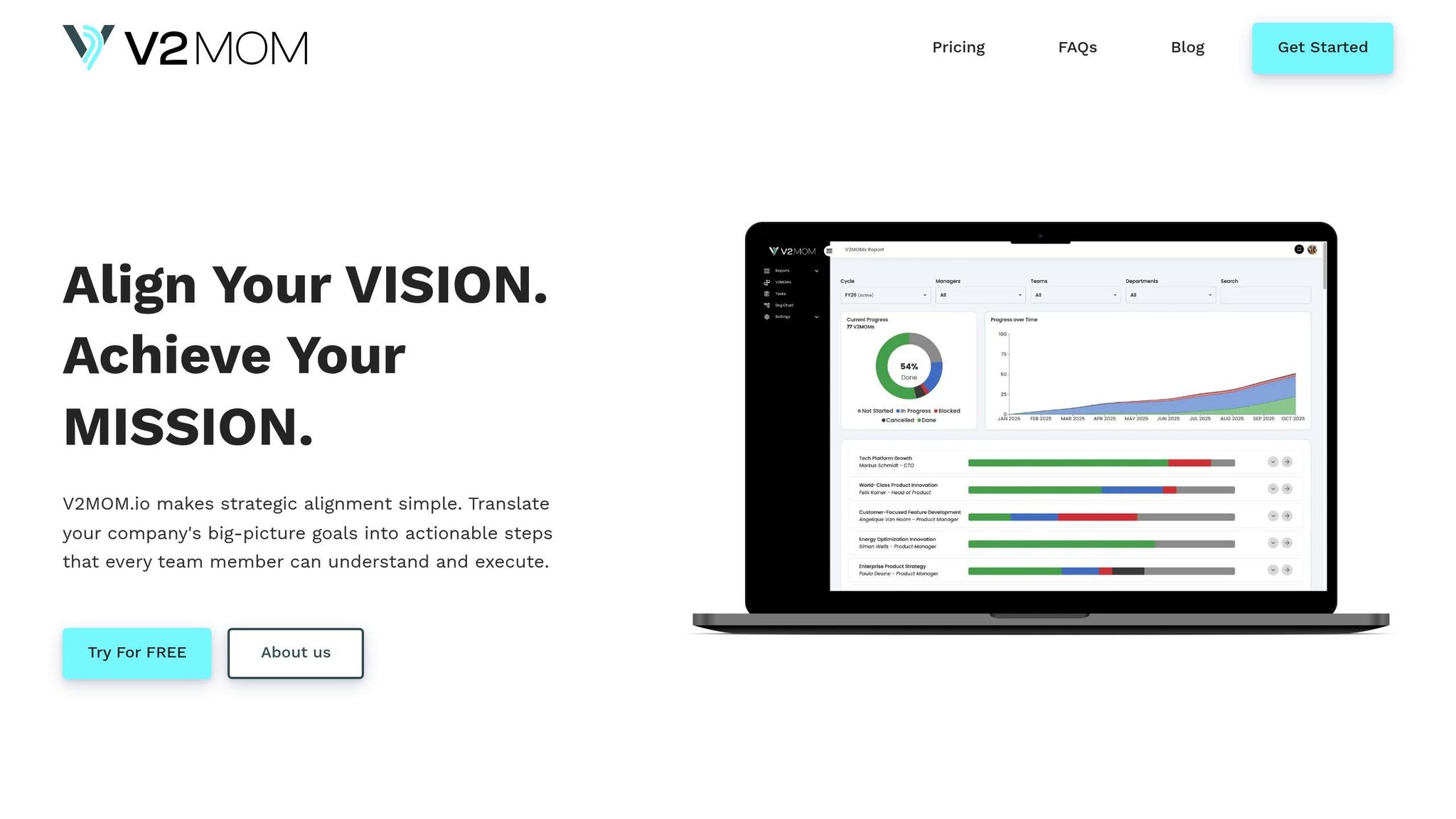
V2MOM.io is a SaaS platform built to centralize Vision, Values, Methods, Obstacles, and Measures, ensuring KPIs are directly tied to your organization’s core goals and purpose [3]. This platform reinforces the importance of connecting everyday tasks with larger strategic objectives. It provides a single, comprehensive view where teams can access the company’s strategic priorities, understand the guiding principles, identify actionable steps, anticipate challenges, and measure success effectively.
The platform is highly adaptable, making it suitable for businesses of all sizes - from startups to large enterprises. Companies can tailor the framework to match their specific focus areas. For instance, a company aiming for sustainability might track metrics like carbon footprint reduction or recycled material usage, while a customer-centric business could focus on customer satisfaction scores and employee well-being.
V2MOM.io offers a free tier for small teams and a Business plan priced at $5.99 per user per month, billed annually.
Features Supporting KPI Alignment
The platform’s interactive dashboards provide real-time performance insights, allowing teams to monitor progress continuously. This immediate feedback empowers quicker decision-making and swift course corrections when needed.
Collaboration tools within V2MOM.io help close communication gaps. Teams and managers can work together to set, track, and refine goals, ensuring individual KPIs align with and contribute to company-wide objectives.
Advanced analytics separate meaningful metrics from vanity numbers, helping organizations pinpoint bottlenecks and refine strategies. AI-powered recommendations further enhance this process by guiding users to fine-tune their methods and measures, keeping everything in step with the organization’s broader vision and values.
An interactive organizational chart adds another layer of clarity by mapping team hierarchies and connecting roles, reporting lines, and individual V2MOM goals. This feature makes it easier to cascade KPIs from the top down. For example, if the company’s objective is to boost customer lifetime value by 20%, Marketing could aim for a 15% increase in Customer Engagement Rate, Sales might target a 25% Existing Customer Upsell Rate, and Customer Service could focus on reducing the Churn Rate by 10% [4]. Additionally, activity insights track engagement in real time, such as goal updates and approvals, helping leadership spot trends and provide timely support. Altogether, these features create a strong foundation for measurable business outcomes.
Benefits of Using V2MOM.io
By centralizing strategy, V2MOM.io eliminates the chaos of juggling disconnected systems. With everyone working within a shared strategic framework, it becomes much clearer how individual efforts contribute to the company’s larger goals.
Real-time monitoring enables organizations to respond to changes 56% faster, while shared metrics improve collaboration across teams, driving efficiency gains of 15–30% [4]. The transparency provided by the platform also boosts employee engagement, with companies experiencing up to 33% higher engagement levels when KPIs are well-aligned [3].
For leaders, V2MOM.io offers the data-driven insights needed to make informed decisions, reducing reliance on guesswork or fragmented information. The platform also supports a continuous improvement cycle, making it easy to establish regular review schedules - whether weekly, monthly, or quarterly. This ensures teams stay on track, refine their strategies, and remain focused on long-term goals, even as market conditions shift. By centralizing strategy and performance tracking, V2MOM.io strengthens the connection between KPIs and your company’s vision across every level of the organization.
FAQs
How can businesses ensure their KPIs reflect their vision and values instead of just being arbitrary metrics?
To make sure KPIs genuinely represent a company’s vision and values, it’s crucial to align these metrics with the organization’s strategic goals and core principles. This means clearly outlining what success looks like, pinpointing measurable outcomes, and ensuring every KPI contributes to the larger mission.
Tools like V2MOM.io can streamline this process by organizing key components such as vision, values, methods, obstacles, and measures in one place. This not only enables real-time progress tracking but also strengthens team collaboration and delivers actionable insights, keeping KPIs relevant and connected to the company’s overarching purpose.
How can companies effectively align KPIs from the organizational level to individual teams and employees?
To ensure KPIs are aligned across your organization, begin by clearly outlining company-wide goals that mirror your vision and core values. Break these overarching goals into specific, measurable objectives for each department. From there, tie individual employee KPIs directly to these departmental objectives, making it clear how each person's efforts contribute to the bigger picture.
Using a centralized platform can simplify this process. It allows you to monitor progress, promote teamwork, and access real-time updates. This approach keeps everyone on the same page and focused on the company’s key priorities.
How do leading and lagging indicators work together to measure progress toward strategic goals?
Leading and lagging indicators work together to give a well-rounded view of how an organization is performing. Leading indicators are forward-looking metrics that hint at what’s likely to happen in the future. For example, customer inquiries or employee engagement levels can help spot trends and guide decisions before issues arise. Lagging indicators, on the flip side, focus on results that have already occurred, such as revenue growth or market share, providing a snapshot of past achievements.
When businesses use both types of indicators, they can monitor progress in the moment while also evaluating long-term outcomes. This approach keeps everyday activities aligned with big-picture goals, ensuring efforts lead to measurable and meaningful results.