When stakeholders aren’t aligned, projects stall, budgets are wasted, and teams lose focus. A shared vision fixes this by creating clarity, improving decision-making, and connecting individual efforts to broader goals. Here’s how to make it happen:
- Map Stakeholders: Identify who influences or is impacted by your project. Use tools like the Power-Interest Grid to prioritize engagement.
- Understand Needs: Gather feedback through surveys and focus groups. Tailor communication to address concerns and priorities.
- Create a Unified Vision: Build a clear, goal-oriented vision that ties stakeholder goals to organizational objectives.
- Communicate Effectively: Use a mix of concise messaging, relatable stories, and regular updates to keep everyone informed and involved.
- Leverage Tools: Platforms like V2MOM.io help centralize goals, track progress, and maintain alignment across teams.
- Monitor Progress: Regularly review goals, adjust as needed, and keep stakeholders accountable.
The key is consistency. By combining clear systems and regular updates, you can keep stakeholders aligned and motivated over the long term. Tools like V2MOM.io simplify this process, ensuring everyone stays connected to the vision.

6-Step Process for Aligning Stakeholders Around a Shared Vision
Webinar: Negotiating stakeholder alignment
Identifying and Mapping Your Stakeholders
The first step in any initiative is recognizing the key players - your stakeholders. These are individuals or groups, either within or outside your organization, who have a vested interest in your objectives. Their involvement can shape outcomes in both positive and negative ways, making their identification a crucial early task [2] [3] [4] [5].
Start this process with a brainstorming session alongside your core team. Ask straightforward questions like: Who will be impacted by this initiative? Who controls the resources we need? Who makes the key decisions? Who could potentially hinder progress? Engaging directly with stakeholders to understand their priorities not only provides valuable insights but also helps establish trust from the outset [3]. This step sets the stage for effective mapping and engagement strategies.
Stakeholder Mapping Techniques
Once stakeholders are identified, organize them using tools like the Power-Interest Grid. This grid is a simple square chart with "Interest" (ranging from low to high) on the horizontal axis and "Power" (ranging from low to high) on the vertical axis. Evaluate each stakeholder based on their level of influence and interest, then plot them as dots in the relevant quadrant [2] [5] [6].
As your project progresses, stakeholder positions may change. Regularly updating your grid ensures it remains accurate. Beyond the Power-Interest Grid, other methods like the Salience Model or the Stakeholder Rainbow Diagram can add depth by factoring in criteria beyond power and interest [7] [8].
Organizing Stakeholder Priorities
How you engage stakeholders should depend on their level of power and interest. For high-power, high-interest stakeholders, maintain close collaboration. Keep high-power, low-interest stakeholders informed of key updates, and provide periodic updates to those with lower power.
Focusing your efforts where they matter most is essential. A participatory approach that includes diverse stakeholders brings in fresh ideas, different viewpoints, and stronger buy-in. It also allows you to address concerns early, increasing the likelihood of success [3]. Tailor your communication to each stakeholder’s role and involvement - listen to their feedback, respond promptly, and share updates that align with their expectations [5].
Understanding Stakeholder Needs and Expectations
Once you've mapped out your stakeholders, the next essential step is figuring out what truly matters to them. This means digging into their unique priorities and what they hope to achieve through their involvement [1][9]. Stakeholders' interests can vary widely - ranging from financial goals and work-related priorities to concerns about environmental impact, safety, or even mental health [3]. Ignoring these details early on can derail even the most carefully laid plans.
To avoid this, focus on active listening and structured feedback. It’s not enough to gather input - you need to address concerns and demonstrate how stakeholder feedback influences decisions [10][9]. Tailor your communication to fit each stakeholder’s preferences. For instance, a C-suite executive might care more about strategic insights, while frontline employees are likely to focus on how changes affect their daily tasks.
Using Surveys and Focus Groups
Surveys and focus groups are powerful tools for gathering insights. Surveys can help you collect both numbers and opinions, but they need to be designed thoughtfully. Make it clear how their feedback benefits not just the organization but also them personally [11]. Keeping questions short and relevant to their roles ensures higher response rates and better data quality [11].
Focus groups, on the other hand, allow you to dive deeper. They’re great for uncovering the "why" behind stakeholder opinions and for identifying concerns that might not come up in a survey. Timing is key for both methods - engage stakeholders early and continue throughout the process [10][9][1]. Early involvement not only helps you spot potential challenges but also shows stakeholders that their input is valued from the start.
Analyzing Common Themes
Once you've collected feedback, the next step is to identify patterns. Look for shared priorities and recurring concerns - these will help you create a vision that addresses what matters most while managing potential conflicts [3]. It’s also important to gauge how strongly stakeholders feel about their interests. Some might be enthusiastic supporters of your vision, while others could work against it - even within the same group [3]. Start by focusing on areas of agreement and use these as a foundation for building consensus on more divisive issues. These shared insights will help align stakeholder goals with your organizational strategy, setting the stage for a vision that resonates across the board.
Creating and Communicating a Unified Vision
Once you've identified stakeholder needs and recurring themes, the next step is to solidify a vision that brings these varied perspectives together. This vision should provide clear direction, focus efforts, and ensure that organizational goals align with everyday tasks. It’s about crafting something that resonates with executives aiming for strategic results while also remaining relatable to frontline employees by connecting to their daily responsibilities.
Your vision should pinpoint specific areas for change, set achievable goals, and cater to the long-term interests of all stakeholders. For example, Cloud Kicks postponed a feature after securing cross-team agreement, only for leadership to override the decision when addressing a critical customer issue became urgent. This highlights the importance of involving all key stakeholders from the very beginning.
Aligning Stakeholder Goals with Organizational Strategy
To align stakeholder goals with your company’s strategy, start by bridging the gap between what stakeholders need and where the business is headed. The goal is to find common ground that benefits both sides. Use the SMART framework to set specific, measurable, time-bound objectives, ensuring everyone knows what success looks like and when it should be achieved.
"The vision is the highest-ordered statement of the desired future or state of what you want your business to achieve." - Denise McNerney, President and CEO of iBossWell, Inc. [12]
Building a Communication Plan
A strong communication plan brings your vision to life, turning it from a static document into a shared understanding. Begin by setting clear communication goals - whether it’s raising awareness, influencing opinions, or encouraging participation. Develop a few key messages that capture the heart of your vision. Use a mix of approaches, such as engaging stories, succinct elevator pitches, and clear visuals, to reach different audiences and create internal advocates.
Plan your communication timeline to align with project milestones and stakeholder activities. Most importantly, ensure your actions reflect the vision you’re promoting. If your behavior doesn’t match your words, credibility will quickly erode. A well-communicated vision not only guides decision-making but also prepares teams for collaboration. Tools like V2MOM.io can help lay the groundwork for effective vision workshops and unified implementation.
sbb-itb-ee93501
Facilitating Collaboration with V2MOM.io
So, you’ve got your communication plan ready - now comes the tricky part: turning that vision into something practical and actionable for everyone on the team. This is where having a centralized platform becomes a game-changer. Without a single, reliable source for everyone to reference, your vision can easily get lost in the shuffle.
Enter V2MOM.io, a platform that brings together your organization’s Vision, Values, Methods, Obstacles, and Measures in one place. By centralizing this information, it ensures every team member is on the same page. This transparency connects individual goals with team objectives and the broader company mission. Take Salesforce as an example: with over 75,000 employees using this framework, any team member can pull up a colleague’s V2MOM on their phone to see their goals and contributions [13].
"The magic of the V2MOM is its simplicity. It's easy to digest, understand, and implement." – Salesforce [13]
What sets V2MOMs apart is their flexibility. They aren’t rigid annual goals but living documents. This adaptability encourages ongoing conversations between managers and employees, supported by tools for tracking progress. As priorities shift or challenges arise, teams can adjust in real time. By combining transparency with regular updates, this platform transforms your vision into a practical, daily guide for alignment.
Running Collaborative Vision Workshops
Workshops are a great way to bring stakeholders together and co-create your vision. These sessions not only foster consensus but also give everyone a chance to contribute. During the workshop, focus on building out the core elements:
- Vision: What are you aiming to achieve?
- Values: What principles will guide decisions?
- Methods: What specific actions will you take?
- Obstacles: What challenges might arise?
- Measures: How will you define success?
Keep these sessions focused and goal-oriented. For larger groups, consider breaking into smaller teams to tackle different pieces of the puzzle, then regroup to finalize a unified vision. The goal isn’t to perfect everything in one go but to create a solid starting point that everyone can rally around. Be sure to document the outcomes and reasoning behind decisions - this will form the foundation for your V2MOM.io implementation.
Using V2MOM.io for Alignment
Once your collaborative framework is in place, the next step is to bring it into V2MOM.io for digital alignment. The platform simplifies the process by cascading V2MOMs from the company level down to teams and individuals. This makes it clear to every employee how their work ties into the company’s broader success [13].
"Every employee in the company has one, making it easy for everyone to know how they contribute to the company's success." – Salesforce [13]
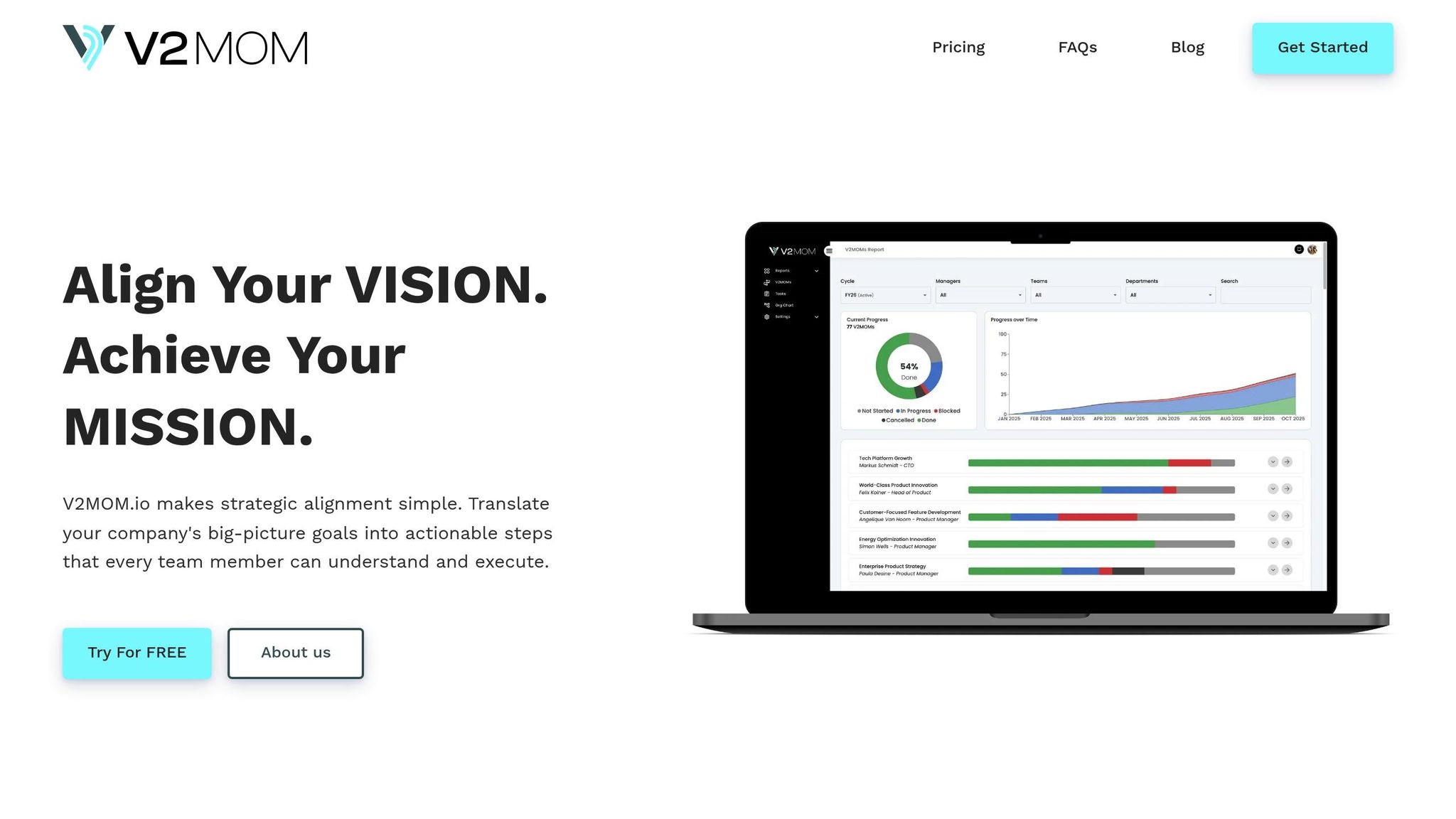
Another standout feature is real-time tracking. Instead of relying on endless status meetings, teams can update their measures on centralized dashboards. Leaders gain instant visibility into progress without needing constant check-ins. Research even shows that 92% of U.S. workers feel more motivated to achieve their goals when their progress is visible to colleagues [14].
The platform also keeps collaboration streamlined. Instead of scattering discussions across Slack or email, teams can comment directly on their V2MOMs. This creates a clear record of decisions and adjustments, making it easier for new team members to get up to speed and for everyone to understand the reasoning behind strategic moves. By keeping everything in one place, V2MOM.io ensures alignment stays actionable and connected to your goals.
Maintaining Alignment Through Monitoring and Accountability
Getting everyone on the same page is tough, but staying focused over time can be even harder. Here’s a stark reality: less than 5% of employees fully grasp their company’s strategy, and a whopping 85% of executive leadership teams spend less than an hour each month discussing it [15]. This highlights the importance of keeping alignment alive through regular monitoring and clear accountability.
Documenting the Shared Vision
Your vision shouldn't be buried in a forgotten slide deck from a meeting months ago. It needs to be accessible and actionable. A centralized, shared document that outlines your vision, values, methods, obstacles, and measures ensures everyone stays on the same page. This "single source of truth" eliminates guesswork and keeps teams focused on what really matters.
Platforms like V2MOM.io can serve as this central hub, making your strategic framework visible to all stakeholders. When everyone can see how their work ties into the bigger picture, it builds trust and clarity. Plus, when priorities inevitably shift, this transparency helps everyone understand why those changes are happening.
Tracking Progress and Making Adjustments
Documentation is just the starting point - you also need to regularly check progress and adapt as necessary. The reality? Only 20% of employees feel like they’re consistently working on the right priorities [16]. That’s why your tracking system needs to go beyond listing tasks; it should show whether those tasks are actually driving results.
Assigning one person to own each objective ensures accountability without creating a micromanagement nightmare. Data should guide decisions. For instance, a European financial-services firm tied employee assessments to cost reduction and innovation goals. This approach pushed every department to identify opportunities for 30%–50% improvements within a year [17].
Another example: a bank inspired its employees by sharing a transformation story that emphasized the benefits for everyone - teams, customers, and even society. This effort led to a 10% efficiency boost in just the first year [17]. By sharing progress openly, adjusting targets when necessary, and keeping the dialogue ongoing, you can ensure your vision evolves alongside your business. After all, a vision should grow and adapt, just like the company it drives.
Conclusion
Bringing stakeholders together under a shared vision is not a one-and-done task - it’s an ongoing, deliberate effort. Start by identifying your key stakeholders and digging into their needs through direct research. Then, create a unified vision that ties their goals to your organization’s strategy, and ensure it’s communicated effectively across all platforms.
This initial groundwork sets the stage for lasting alignment.
The challenge for many organizations comes after the initial success. Sustaining alignment requires continuous effort - keeping everyone on the same page through regular monitoring and accountability. When stakeholders see how their efforts contribute to the larger mission and can track progress in real time, their engagement remains strong, and the shared vision stays relevant.
Tools like V2MOM.io simplify this process by centralizing critical strategic elements - vision, values, methods, obstacles, and measures - into one accessible hub. Instead of juggling scattered spreadsheets and outdated slide decks, stakeholders have a single source of truth with actionable insights. When priorities shift or progress slows, real-time data pinpoints what needs to change.
Sustained alignment thrives on systems that are quick to update, foster transparency, and maintain focus. A platform that lets you make updates in minutes, builds trust through clarity, and keeps goals alive well beyond the initial rollout isn’t just a convenience - it’s essential. Strategic alignment leads to stronger growth, better talent outcomes, and higher employee engagement by giving everyone a clear sense of purpose and direction [16].
Your stakeholders are eager to move forward together. With clear systems and the ability to adapt in real time, you can ensure their efforts consistently push the vision ahead - not just for the next quarter, but for years to come.
FAQs
How do I identify and organize stakeholders for my project?
To get a handle on your stakeholders, start by clarifying your project’s goals and desired outcomes. Think about who might influence or be affected by the project - this could include individuals, teams, departments, customers, suppliers, regulators, or even community groups. Gather essential information about each stakeholder, like their role, their decision-making authority, and how invested they are in the project.
From there, assess each stakeholder’s influence (how much they can shape the project) and interest (how much they care about the results). A power-interest matrix can make this easier. For instance, stakeholders with both high influence and high interest should be closely involved, while those with lower influence and interest might just need periodic updates.
Once you’ve mapped out your stakeholders, focus on how you’ll communicate and engage with them. Plan regular updates for key players, set up spaces for collaboration with partners, and adjust how often you communicate based on each group’s involvement. Tools like V2MOM.io can be handy for organizing stakeholder details, assigning tasks, and ensuring everyone stays aligned with the project’s vision. Don’t forget to revisit your stakeholder map regularly - things can change, and keeping everyone on the same page is crucial for progress.
What are the best ways to keep stakeholders aligned over time?
To keep stakeholders on the same page, prioritize consistent communication, clear objectives, and shared accountability. A great way to start is by organizing your vision, values, methods, obstacles, and measures (V2MOM) into one centralized, easily accessible platform. This setup allows stakeholders to monitor progress and flag potential issues in real time. Regular check-ins - whether monthly or quarterly - are crucial for assessing progress, addressing challenges, and fine-tuning strategies to ensure plans remain practical and actionable.
Engage stakeholders early and frequently by clearly defining their roles, such as decision-maker, advisor, or contributor. This clarity fosters a sense of ownership and collaboration. Keep alignment strong with transparent updates, compelling storytelling, and consistent reinforcement of the shared vision. Use formats like team meetings, newsletters, or dashboards to communicate effectively. This approach keeps everyone engaged and working toward the same objectives.
How does V2MOM.io help stakeholders work together and stay aligned?
V2MOM.io makes teamwork and alignment easier by offering a centralized, cloud-based platform where teams can define and update their Vision, Values, Methods, Obstacles, and Measures. Instead of juggling multiple documents, everyone gets real-time access to a single, shared strategy with clear, actionable goals.
The platform encourages smooth collaboration with tools like shared editing, real-time progress tracking, and interactive dashboards that highlight key metrics. Features such as threaded discussions, activity insights, and automated reports ensure communication stays organized and efficient. Plus, an interactive org chart connects roles to their specific objectives, promoting transparency throughout the organization.
By consolidating strategic planning and providing instant updates, V2MOM.io enables every team member to actively contribute to a shared vision, transforming alignment into an ongoing, collaborative effort.