V2MOM is a planning framework (often compared to OKRs) created by Salesforce CEO Marc Benioff to help organizations align their goals, actions, and outcomes. It stands for Vision, Values, Methods, Obstacles, and Measures. The key to its success? Embedding measurement into every step to ensure progress is tracked and strategies stay on course.
Here’s why it matters:
- Clear Metrics: Goals are paired with measurable outcomes, so success is never a guessing game.
- Alignment Across Teams: Every employee’s work ties directly to organizational goals.
- Accountability: Transparent tracking keeps everyone focused on results, not just effort.
- Data-Driven Decisions: Analytics replace assumptions with actionable insights.
The "Measures" component is central, using SMART goals to define what success looks like. Teams track progress with specific KPIs, like customer retention rates or revenue growth. Tools like dashboards and regular reviews ensure plans stay relevant and actionable.
Key Takeaways:
- V2MOM Framework: Vision (what you want), Values (what matters), Methods (how to get there), Obstacles (challenges), Measures (how to track success).
- SMART Goals: Specific, Measurable, Achievable, Relevant, Timely.
- Two Types of Measures: Progress (e.g., revenue targets) and Completion (e.g., project deadlines).
- Regular Reviews: Frequent check-ins keep strategies on track and adaptable.
By combining clear goals with analytics and transparency, V2MOM turns strategy into results.
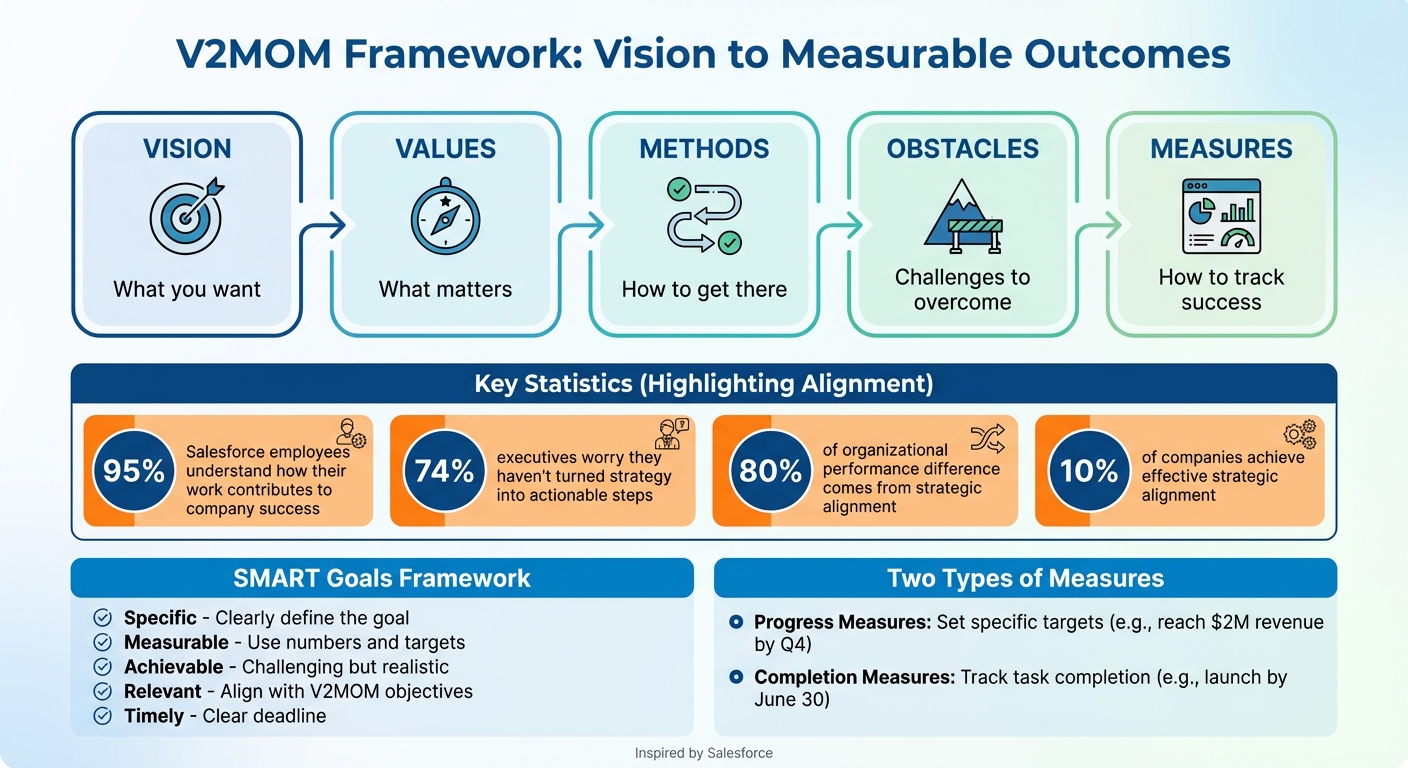
V2MOM Framework: 5 Components for Strategic Alignment
👉 “V2MOM Framework Explained | The Salesforce Strategy Behind 10x Company Growth 🚀”

sbb-itb-ee93501
The Role of Measures in V2MOM Analytics
Measures are the foundation of V2MOM - they’re the numbers that show whether your strategy is on track or veering off course. Without them, you’re left guessing; with them, you set clear benchmarks that reveal whether your efforts are advancing your vision.
Here’s a startling reality: 74% of executives worry they haven’t successfully turned their business strategy into actionable steps, and only 35% believe their current strategy will lead to success [6]. Why the disconnect? Often, it’s because teams lack measurable outcomes. Measures, however, enforce clarity from the start.
"Measures challenge us to call out, right from the start of our journey, what success looks like - and holds us to it." - Salesforce [6]
Instead of tracking daily tasks, measures focus on results. For example, rather than logging hours worked, measures could track outcomes like improved customer retention or completing a product launch by Q2. This approach ensures teams stay focused on work that drives meaningful impact.
Creating Effective Measures
To be effective, measures should follow the SMART framework: Specific, Measurable, Achievable, Relevant, and Timely [1]. This ensures every measure is clear, actionable, and tied to a deadline. For example, instead of saying, "improve customer satisfaction", reframe it as, "achieve a 75% customer satisfaction score by December 31, 2026."
There are two main types of measures to consider:
- Progress Measures: These set a specific target, like "reach $2 million in revenue by Q4."
- Completion Measures: These track whether a specific task is finished, such as "launch internal knowledge base by June 30, 2026" [1].
Both types ensure accountability by defining clear objectives from the beginning.
| SMART Component | Description |
|---|---|
| Specific | Clearly define the goal and what needs to be achieved. |
| Measurable | Use numbers, percentages, or targets to track progress. |
| Achievable | Set goals that are challenging but realistic. |
| Relevant | Align the measure with broader V2MOM objectives. |
| Timely | Assign a clear and reasonable deadline. |
It’s important to prioritize measures by listing them in order of importance [1]. When resources are tight, this prioritization helps teams focus on what matters most. To avoid conflicting data and maintain clarity, organizations should limit themselves to no more than 25 measures total, or about one to two per strategic objective [5].
For a well-rounded strategy, balance outcome measures (lagging indicators like revenue or customer renewal rates) with driver measures (leading indicators such as training hours or product adoption rates). This combination not only tracks results but also highlights the activities that drive those results [5].
How Measures Create Accountability
Once measures are clearly defined, transparent tracking ensures accountability. Measures make goals visible and actionable. At Salesforce, for instance, every employee’s V2MOM is accessible to all 75,000+ employees [4]. This level of transparency helps everyone understand how their work supports the company’s broader vision.
"If you're not able to measure it, you probably don't understand what you are trying to achieve." - Salesforce Trailhead [1]
Regular reviews are key. By evaluating measures monthly, teams can stay aligned with their strategic plan [5]. This process transforms the V2MOM into a dynamic document. Instead of waiting for end-of-year reviews, teams can make real-time adjustments based on their progress [6].
Measures also promote collaboration. When shared metrics connect one team’s challenge to another team’s solution, silos break down, and everyone works toward the same outcomes [1]. Frequent reviews ensure that strategic shifts remain tied to measurable results, keeping everyone aligned and accountable.
Key Metrics and KPIs for V2MOM
Choosing the right metrics can turn V2MOM into more than just a planning framework - it becomes a strategic powerhouse. The key is to focus on metrics that reflect actual outcomes rather than just tracking activities. Instead of counting how many meetings were held, for instance, look at whether customer retention rates are climbing or if product adoption has grown by a specific percentage.
Outcome-Based Metrics
Outcome-based metrics zero in on the results of your Methods - the tangible impact on your Vision. These are lagging indicators that show whether your strategy is hitting the mark. Swap out vague goals for clear, measurable targets like: "Capture a 30% market share in the United States by the end of the fiscal year" [1].
Different industries define these metrics based on their unique strategic goals.
"Measures define the key performance indicators (KPIs) or metrics that will be used to track progress and success toward achieving the organization's vision. They answer the question: 'How will we know if we're successful?'" - Gennaro Cuofano, Creator of FourWeekMBA [3]
Balancing outcome measures with driver measures is equally important. Driver measures act as leading indicators that influence your results. For example, while customer renewal rates are an outcome, the number of customer check-in calls is a driver that directly impacts that outcome [5]. This pairing provides a clear picture of both what was achieved and how it was achieved.
These insights naturally complement progress metrics, which keep teams focused and aligned.
Progress Indicators for Team Alignment
Progress indicators track everyday activities and directly connect them to broader strategic goals. At Salesforce, 95% of employees say they understand how their work contributes to the company’s success, thanks to the V2MOM process [7].
These indicators often pair numerical goals with specific milestones. For example, a target like "achieve a 75% open rate for customer email campaigns by Q2" can be supported by milestones such as "launch an internal communications blog by the end of Q4" [1].
To ensure teams stay focused, it’s essential to prioritize these measures. Listing them in order of importance helps teams know where to direct their energy when resources are tight [1].
Using Analytics to Measure Organizational Alignment
Alignment metrics take things a step further by integrating individual and progress metrics across departments. They shine a light on how well the entire organization is working toward shared goals. These metrics reveal whether various teams and levels are coordinating effectively.
Just as individual metrics create accountability, transparent goal setting fosters organization-wide alignment. At Salesforce, employees can view one another’s V2MOMs, which increases visibility and breaks down silos. When one team faces a challenge, another team can often step in with a solution through their Methods [1].
Regular reviews keep alignment metrics actionable. Weekly one-on-one meetings and a formal mid-year refresh allow companies to adapt to changing conditions [7]. These cycles ensure that the V2MOM framework isn’t just a one-time exercise but an ongoing process that keeps strategies flexible and relevant.
For even greater efficiency, tools like V2MOM.io can simplify this process. With features like real-time dashboards, collaborative tools, and instant insights, platforms like this make it easier to integrate key metrics into daily workflows, ensuring that strategies remain adaptable and outcomes measurable.
Setting Up an Analytics System for V2MOM
Once you've defined clear measures, the next step is to create an analytics system that turns your strategy into actionable insights. Starting with SMART measures helps establish benchmarks that are both specific and measurable[1]. Many executives struggle to bridge the gap between strategy and execution, but a well-structured analytics system can make strategic goals tangible and trackable.
Building Dashboards for Real-Time Insights
Real-time dashboards can replace the outdated reliance on end-of-quarter reports, allowing teams to make timely adjustments as needed[2]. These dashboards should differentiate between two key types of metrics: Progress Measures (like "achieve a 75% email open rate") and Completion Measures (such as "launch internal blog by Q4")[1]. Prioritize these metrics based on their importance to ensure focus on what matters most[8].
To make progress easy to interpret, visual tools like heat maps or Red/Amber/Green status indicators can be used[2]. Dashboards should also allow for cascading views, letting users toggle between high-level corporate goals and team-specific V2MOM objectives. This helps connect daily tasks with the organization’s overall vision[5, 14].
Automation plays a crucial role here. By using dedicated platforms, teams can eliminate manual reporting and work from a single, unified source of truth during check-ins[5, 13]. For example, Salesforce leveraged such systems to scale from a small startup to a global organization with over 50,000 employees, all while maintaining alignment and focus[6].
Centralizing Data for Seamless Collaboration
Data silos are the enemy of collaboration. When you centralize data into one platform, everyone operates from the same source of truth, ensuring consistency and transparency[5, 15]. At Salesforce, this approach has been instrumental - V2MOMs are published on their internal network, making every goal visible and searchable, from the CEO's objectives to those of entry-level employees[12, 13].
Centralized data fosters cross-functional problem-solving. For instance, when one team shares their draft V2MOM with others, they might find that their "Obstacles" align with another team’s "Methods"[1]. This transforms V2MOM from a top-down directive into a collaborative, feedback-driven process[7]. Using shared documents for drafting allows team members to provide real-time comments and suggestions, ensuring alignment and buy-in before goals are finalized[7].
However, transparency should not come at the cost of usability. The system must be intuitive enough so that updates take minutes, not hours[1, 2]. Platforms like V2MOM.io simplify this by consolidating vision, values, methods, obstacles, and measures into a single, easy-to-use space. These tools eliminate the need for scattered spreadsheets and disconnected systems, streamlining both progress tracking and collaboration.
Establishing Regular Review Cycles
With centralized data and transparent dashboards in place, regular review cycles are essential to keep strategies on track and adaptable. A structured review process ensures that the V2MOM framework stays relevant and actionable. For example, weekly one-on-one meetings can monitor individual progress, while quarterly team meetings provide an opportunity to share updates and refine action plans. A mid-year review can help adjust the V2MOM to reflect any major shifts in priorities[12, 3].
At Salesforce, every employee is required to create and publish their V2MOMs on time, ensuring organization-wide alignment[7]. Dedicated alignment meetings - lasting 2–4 hours - are scheduled to review and discuss draft V2MOMs, fostering team-wide agreement on priorities[7].
The review process should also include Confidence Assessments and continuous issue tracking. These provide a qualitative layer to complement the quantitative data, offering a more comprehensive view of progress[9]. By combining regular check-ins with data-driven adjustments, organizations can keep their strategies flexible and responsive, ensuring the V2MOM framework continues to drive long-term success.
Improving V2MOM with Continuous Data Insights
V2MOM is not a static document - it’s a living framework that needs regular updates to stay relevant in a fast-changing landscape[7]. Customer preferences evolve, new competitors emerge, and internal priorities shift. Without continuous data insights, your V2MOM risks becoming outdated almost as soon as it’s created.
One of the biggest challenges executives face is bridging the gap between strategy and execution. It’s not that the initial planning is flawed - it’s the inability to adapt as conditions change. Regular updates, grounded in data, ensure that strategies remain actionable and aligned with current realities.
Using Data to Refine Strategies
Real-time performance data is a game-changer when it comes to assessing whether your Methods and Measures are still effective. For instance, when quarterly reviews reveal that certain measures are off track, it’s a signal to dig deeper. Are the methods outdated? Have market conditions shifted? Or are resources being stretched too thin[2]?
Salesforce has perfected this process by integrating continuous data reviews into its operations. This approach has led to 95% of its employees reporting clarity on how their work contributes to the company’s overall success[7]. The key? Regular progress discussions - quarterly and mid-year refreshes - that keep everyone aligned with shifting business realities.
As Marc Benioff, CEO of Salesforce, puts it:
"Success depends on constant communication and complete alignment - we've been able to achieve this through V2MOM."[6]
This approach replaces traditional, static planning with a dynamic "test, revise, deploy" model, enabling teams to respond effectively to technological advancements and market changes[6].
Responding to Change with Real-Time Data
Real-time dashboards are invaluable for making quick adjustments, whether you’re tackling challenges or seizing new opportunities[2]. Tools like V2MOM.io make this process seamless by offering instant insights into progress and potential blockers. Waiting until a quarterly review to identify problems can result in lost time and missed chances.
Data also serves as a critical filter for evaluating new opportunities. By comparing potential projects against your established Methods and Measures, you can make objective decisions to decline or delay initiatives that don’t align with your goals[7]. This level of discipline minimizes scope creep and keeps teams focused on priorities.
The Obstacles component of V2MOM plays a vital role here. By identifying potential blockers early, teams can create contingency plans before risks escalate. This proactive approach ensures that challenges are addressed before they disrupt progress[10][1].
Building a Data-Driven Culture
Real-time insights are just the beginning. To truly adapt, organizations need to embed a data-driven mindset into their culture. Transparency is key. For example, Salesforce publishes all V2MOMs on its internal network, allowing every employee to see how their work connects to the company’s overall vision[7]. This openness fosters collaboration and accountability, with teams supporting each other to achieve shared goals.
When V2MOMs are openly shared, one team’s Obstacle can inspire another team’s Method, turning potential roadblocks into creative solutions. Collaborative drafting through shared platforms ensures that everyone not only understands their objectives but also grasps the broader purpose behind them[7][3].
Platforms like V2MOM.io simplify this process by centralizing all elements - vision, values, methods, obstacles, and measures - in one place. Updates take minutes instead of hours, making it easy to keep V2MOMs current and seamlessly integrated into daily workflows. This approach ensures that the framework remains practical and sustainable over time.
Conclusion
A staggering 80% of the difference in organizational performance boils down to strategic alignment[11]. Yet, only 10% of companies manage to achieve it effectively[11]. The challenge isn't in crafting a vision - it’s in measuring progress and staying on track.
This is where V2MOM analytics steps in, bridging the gap by turning strategy from a once-a-year exercise into an ongoing, actionable system. By integrating the framework’s five components with real-time data, assumptions are replaced with clarity. You gain a precise understanding of your position, what’s succeeding, and what requires adjustment. As Marc Benioff aptly states:
"You need data and metrics to determine what success looks like." [8]
Companies with strong strategic alignment see tangible results: 57% better project outcomes, 50% more on-time deliveries, and 45% improved budget performance[11]. These results stem from connecting daily work to measurable goals, ensuring that every effort contributes to the bigger picture.
Transparency amplifies these benefits. When employees can clearly see how their tasks align with the company’s vision, accountability becomes a shared responsibility. One team’s roadblock can transform into another team’s opportunity to assist and collaborate.
The power of the V2MOM framework lies in its simplicity and structure. It not only makes goal-setting straightforward but also streamlines updates. With V2MOM.io centralizing your vision, values, methods, obstacles, and measures, updating your strategy takes minutes - not hours. This keeps your strategy fresh, your team aligned, and your data driving everyone toward the same destination.
FAQs
How does the V2MOM framework help align teams with company goals?
The V2MOM framework breaks strategy into five straightforward components: Vision (the future you aim for), Values (the principles guiding decisions), Methods (the actions to take), Obstacles (potential challenges), and Measures (specific metrics to track success). This structure creates clarity, helping every team see exactly how their efforts tie into the company’s larger goals. The result? Less confusion and more collaboration.
Leadership kicks things off by crafting a company-wide V2MOM. From there, individual teams tailor the framework to fit their specific responsibilities. Regularly revisiting Measures, updating Obstacles, and tweaking Methods keeps the strategy on track and ensures progress is measurable.
Tools like V2MOM.io make this process even smoother by pulling all these elements into a single platform. With features like real-time updates, collaboration tools, and visual dashboards, it’s easier than ever to turn strategy into action and keep everyone moving in the same direction.
How do SMART goals fit into the V2MOM framework?
SMART goals play a crucial role in the Measures section of the V2MOM framework. These goals - Specific, Measurable, Achievable, Relevant, and Time-bound - offer clear benchmarks and deadlines, making it easier to track progress effectively.
When integrated into the V2MOM framework, SMART goals help bridge the gap between overarching vision, core values, and actionable methods. They turn big-picture ideas into measurable performance indicators, allowing teams to monitor progress, tackle issues promptly, and keep the overall strategy aligned and moving forward.
How can organizations track progress effectively using V2MOM measures?
To keep track of progress with V2MOM effectively, start by making sure each Measure is a SMART metric - that means it's Specific, Measurable, Achievable, Relevant, and Time-bound. For instance, you might set goals like achieving $5M in year-over-year revenue growth, reducing customer churn to under 3%, or maintaining on-time delivery rates at 95% or higher. These targets should tie directly to your vision and methods, and they should be clearly outlined in your V2MOM framework.
It’s important to review these measures on a regular basis. Monthly check-ins and quarterly updates work great to evaluate how your actual performance stacks up against your goals. These reviews are also a good time to identify any gaps, tweak your methods, or tackle obstacles that might be slowing you down. Tools like V2MOM.io make this process easier by offering real-time dashboards, automated reminders, and collaboration features to help keep everyone on the same page.
Make sure this tracking process becomes a regular part of your V2MOM cycle. After each review, update your measures to align with new priorities or goals, and take note of any key insights you’ve gathered. This ongoing, iterative process helps your team stay focused on what matters, avoid inefficiencies, and deliver measurable results.