When it comes to goal-setting frameworks, V2MOM stands out by focusing on vision, values, and alignment. Created by Salesforce's Marc Benioff, it ensures clarity across large organizations by addressing five key areas: Vision, Values, Methods, Obstacles, and Measures. Unlike other models like OKRs, SMART Goals, 4DX, or EOS, V2MOM emphasizes proactive planning and cultural alignment, making it a strong choice for scaling businesses.
Key Takeaways:
- V2MOM: Aligns long-term goals with company values; great for large organizations.
- OKRs: Focuses on quarterly, measurable outcomes; ideal for fast-paced, agile environments.
- SMART Goals: Best for individual, short-term objectives; lacks broader organizational alignment.
- 4DX: Prioritizes execution and accountability; useful for teams managing competing priorities.
- EOS: Targets operational discipline for smaller businesses (10–250 employees).
Quick Comparison:
| Framework | Focus | Best For | Review Cycle |
|---|---|---|---|
| V2MOM | Vision, Values, Obstacles | Large organizations | Annual/Semi-Annual |
| OKRs | Measurable Results | Agile teams, tech companies | Quarterly |
| SMART | Specific, Measurable Goals | Individual tasks/projects | As needed |
| 4DX | Execution of Key Goals | Teams with competing tasks | Weekly |
| EOS | Operational Processes | Small to mid-sized businesses | 90-day cycles |
Each framework has its strengths, but V2MOM’s focus on alignment and proactive planning makes it especially effective for ensuring that every team member contributes to long-term goals. Tools like V2MOM.io simplify this process further by centralizing goal tracking and updates.
V2MOM vs OKRs vs SMART Goals vs 4DX vs EOS Framework Comparison
E5 - Common Strategy Frameworks And How To Master Them
V2MOM vs. OKRs
Choosing the right strategic framework often comes down to understanding the distinct focus of each. Both V2MOM and OKRs are designed to set goals and track progress, but they take very different approaches. OKRs, short for Objectives and Key Results, are widely used in tech companies like Google and Intel. These frameworks pair ambitious goals with measurable outcomes, and teams typically review them every quarter. On the other hand, V2MOM is a more comprehensive tool, often planned on an annual or semi-annual basis. This broader approach makes it particularly effective for long-term planning. Let’s break down the key differences.
Key Differences Between V2MOM and OKRs
The main distinction lies in what each framework emphasizes. OKRs focus heavily on measurable outcomes and encourage teams to set stretch goals that challenge the status quo. Meanwhile, V2MOM centers on vision, values, and alignment, ensuring that strategies align with the organization's culture and ethical principles [1].
One standout feature of V2MOM is its "Obstacles" component. This requires teams to identify potential challenges early on and allocate resources to address them before they become issues [1]. In contrast, OKRs tend to address obstacles reactively during their quarterly reviews. OKRs also emphasize stretch goals - targets designed to push teams to excel, even if they only achieve 70–80% of the goal [7].
Another key difference is the review cycle. OKRs operate on a quarterly schedule, making them ideal for fast-paced environments. V2MOM, however, often follows an annual or semi-annual timeline, offering a steady guiding framework for long-term decisions and alignment [2].
"Alignment is critically important in large companies... I prefer V2MOM over other cascading goal frameworks because it inspires creativity, change and empowerment." - Marc Benioff, CEO, Salesforce [3]
These differences influence how each framework shapes strategic outcomes, as explored below.
Where V2MOM Outperforms OKRs
V2MOM shines in situations where cultural alignment and transparency are just as critical as hitting performance metrics. By clearly outlining core values, V2MOM ensures teams not only know what they’re working toward but also how to approach their goals. This is especially effective for large organizations that need to maintain a unified culture across thousands of employees, as seen with Salesforce’s global success [3].
The framework's proactive approach to problem-solving - anticipating challenges before they arise - helps companies allocate resources wisely and avoid unexpected setbacks. Research shows that organizations with strong alignment between business and technology strategies are 1.5 times more likely to achieve their goals. Additionally, companies with high employee alignment see a 21% boost in profitability and a 17% increase in productivity [9].
OKRs, on the other hand, often adopt a "bottom-up" approach, where teams propose their own key results to align with broader objectives. While this encourages ownership, it can sometimes lead to misalignment if teams interpret objectives differently. V2MOM avoids this pitfall by cascading goals from the top down, ensuring consistency across the organization [1].
"A well-crafted vision ensures every subsequent action contributes to getting upcoming positive results." - Aurore, Product Manager, Coachyz [1]
Comparison Table
| Feature | V2MOM | OKRs |
|---|---|---|
| Primary Focus | Vision, Values, and Alignment | Measurable Results and Performance |
| Structure | 5 Elements (Vision, Values, Methods, Obstacles, Measures) | 2 Elements (Objectives, Key Results) |
| Review Cycle | Typically Annual/Semi-Annual | Typically Quarterly |
| Unique Element | Obstacles: Proactive identification of challenges | Stretch Goals: Ambitious targets |
| Cultural Integration | High (explicitly incorporates core values) | Lower (focuses mainly on metrics) |
| Risk Management | Addresses potential obstacles upfront | Reactively addresses challenges |
| Ideal Use Case | Large organizations, long-term strategic planning | Startups, agile teams, rapid growth |
| Collaboration | Emphasizes shared values to reduce individualistic approaches | Involves teams in defining their own key results |
Some organizations find a hybrid approach works best. They use V2MOM to establish a clear annual vision and values, while leveraging OKRs for quarterly execution and tracking measurable milestones. This combination allows for both long-term alignment and short-term adaptability.
V2MOM vs. SMART Goals
SMART goals focus on setting objectives that are Specific, Measurable, Achievable, Relevant, and Timely, while V2MOM takes a broader approach. It serves as a strategic framework, covering Vision, Values, Methods, Obstacles, and Measures to create a clear roadmap for organizational success[10].
Some organizations, like Salesforce, integrate SMART principles into their V2MOM framework. This is particularly evident in the "Measures" and "Methods" sections, where SMART ensures goals are both actionable and measurable[10][12]. Think of V2MOM as the overarching strategy and SMART as the fine-tuning tool for individual milestones along the way. Each framework has its place, depending on the scope and needs of your organization.
Key Features of V2MOM vs. SMART Goals
The main difference between these two models lies in their scope and approach. SMART goals are ideal for defining specific, measurable objectives at the individual or small team level. They focus on metrics and deadlines without diving into broader organizational values. On the other hand, V2MOM operates on a larger scale, incorporating "Values" to guide decision-making and behaviors - a layer absent in the metric-driven SMART model[6][10].
Another notable distinction is how V2MOM addresses potential challenges. While SMART assumes a straightforward path to achieving goals, V2MOM explicitly requires teams to identify "Obstacles" and allocate resources to tackle them in advance[1][15]. This proactive approach can save teams from common pitfalls, such as unclear objectives - a problem 40% of executives report facing[14].
Transparency is another strength of V2MOM. At Salesforce, for example, all 75,000+ employee V2MOMs are accessible internally, allowing everyone to see how their work aligns with the company's larger priorities[6][12]. In contrast, SMART goals, when used alone, can sometimes lead to siloed efforts, where individuals focus solely on their own targets without connecting to the broader organizational vision.
"We chose V2MOM because it starts with the big picture... A long-term, clearly articulated vision serves as the 'North Star' when it comes to plotting a course or making a decision." - David Ciccarelli, CEO, Voices[3]
Which Framework Fits Your Business Needs
Choosing the right framework depends on whether you're managing tactical tasks or aligning your organization around a shared vision.
- Use SMART goals for clearly defined, measurable outcomes tied to specific tasks or projects. They're perfect for tactical execution, like launching a product feature, meeting a sales target, or completing a training program within a set timeframe.
- Choose V2MOM when you need company-wide alignment and a strategic roadmap. It’s especially helpful in scaling organizations, ensuring every employee understands how their daily work connects to the larger vision. For example, Salesforce credits V2MOM as a key driver in reaching $5 billion in annual revenue within 15 years[11].
Many organizations find that combining these frameworks is the most effective approach. Start with an annual V2MOM to outline your "North Star" vision and values. Then, apply SMART criteria within the "Measures" and "Methods" to make goals time-bound and quantifiable[10][12]. Sharing the V2MOM across teams can also encourage collaboration, as one team’s "Obstacle" might be addressed by another’s "Method"[12].
Comparison Table
| Feature | V2MOM | SMART Goals |
|---|---|---|
| Primary Purpose | Organizational alignment and strategy | Defining clear, measurable objectives |
| Scope | Broad (Vision, Values, Methods, etc.) | Narrow (criteria for a single goal) |
| Best For | Company-wide strategy | Individual tasks or milestones |
| Cultural Component | High (includes Values) | Low (focuses on metrics and deadlines) |
| Risk Management | Proactive (addresses Obstacles upfront) | Reactive (assumes a clear path) |
| Scalability | Cascades across the organization | Applied at task or individual level |
| Transparency | Company-wide visibility | Typically private or team-specific |
| Relationship | Parent framework | Refines V2MOM "Measures" |
V2MOM vs. 4DX
Let’s dig deeper into how V2MOM stacks up against 4DX when it comes to execution.
The 4 Disciplines of Execution (4DX) is a structured framework designed to focus on Wildly Important Goals (WIGs). It narrows a team’s attention to the most critical objectives. On the other hand, V2MOM acts as a comprehensive guide, combining strategy and execution. By focusing on Vision, Values, Methods, Obstacles, and Measures, it provides a broader perspective, helping teams see how their individual efforts tie into the bigger picture.
How V2MOM and 4DX Tackle Execution
V2MOM takes a proactive approach by laying out clear actions (Methods) and identifying potential challenges (Obstacles) upfront. This allows teams to anticipate issues and allocate resources effectively. In contrast, 4DX zeroes in on Lead Measures - specific, predictive actions that influence outcomes. It also incorporates tools like scoreboards and regular accountability meetings to track progress. For instance, in a sales context, tracking daily calls might serve as a lead measure for boosting revenue.
Measurement is another area where the two frameworks diverge. V2MOM uses a balanced mix of lagging, leading, and counter KPIs, ensuring no single metric dominates decision-making. Meanwhile, 4DX emphasizes lead measures, supported by lag measures that reflect results. Both systems address the daily chaos of work: 4DX separates essential goals from routine tasks, while V2MOM acts as a guiding star, aligning daily activities with the overarching vision. This clarity not only simplifies execution but also enhances teamwork.
Team Collaboration in V2MOM
Collaboration is a standout feature of V2MOM. Its emphasis on transparency breaks down silos, making it clear how each team member’s work supports the overall vision. Explicitly addressing obstacles fosters psychological safety, encouraging teams to discuss challenges openly. This collective approach strengthens alignment across the organization.
While 4DX promotes engagement through scoreboards and structured meetings, V2MOM leans on shared values to inspire creativity. Teams are encouraged to explore innovative ways to meet goals, creating a more dynamic and collaborative environment.
Comparison Table
| Feature | V2MOM | 4DX |
|---|---|---|
| Primary Execution Focus | Methods and Obstacles | Wildly Important Goals (WIGs) |
| Measurement Type | Balanced (Lagging, Leading, Counter KPIs) | Lead Measures (Predictive) and Lag Measures |
| Obstacle Management | Clearly identified and planned for | Addressed by separating WIGs from routine tasks |
| Collaboration Style | Transparency and shared Values | Accountability through scoreboards and meetings |
| Document Length | One-page roadmap | Detailed framework |
| Flexibility | Highly adaptable for teams or individuals | More structured, focusing on defined disciplines |
| Progress Tracking | Ongoing updates, visible to all | Real-time tracking with scoreboards |
| Scalability | Works across entire organizations | Typically applied at the team level |
Both V2MOM and 4DX bring unique strengths to the table. Choosing between them often depends on whether a team needs a flexible, vision-driven approach or a disciplined, goal-specific framework.
sbb-itb-ee93501
V2MOM vs. EOS
V2MOM and EOS represent two distinct approaches to managing and scaling businesses. At its core, V2MOM focuses on vision and values, creating a framework that ties strategic goals to everyday tasks. EOS, on the other hand, emphasizes operational discipline, using six defined components: People, Vision, Data, Process, Traction, and Issues. The difference between these approaches - one rooted in strategic vision and the other in operational precision - shapes how each framework performs in businesses of varying sizes.
Vision-Driven vs. Operations-Centered Approaches
V2MOM prioritizes the "what" and "why" of a business by focusing on Vision and Values. It’s designed as a concise, one-page document that aligns daily actions with long-term objectives. David Ciccarelli, CEO of Voices, describes its appeal:
"We chose V2MOM because it starts with the big picture... A long-term, clearly articulated vision serves as the 'North Star' when it comes to plotting a course or making a decision" [3].
EOS, however, is all about execution. It relies on structured processes, such as 90-day goals called "Rocks" and standardized meeting formats like Level 10 meetings, to address operational challenges. Issues are tackled systematically through an "Issues List" during these meetings [4]. Unlike the lightweight and adaptable V2MOM, EOS is more rigid and often requires a professional implementer to help businesses navigate its 22 tools [17][4].
Why V2MOM Scales Better for Large Businesses
One of V2MOM’s standout strengths is its ability to scale. Its vision-first design enables organizations like Salesforce, with more than 75,000 employees, to maintain alignment. At Salesforce, every employee creates a personal V2MOM that cascades from the corporate version [6]. This organization-wide transparency, where everyone’s V2MOM is accessible, fosters both accountability and a shared sense of purpose [4]. By linking individual goals to the company’s broader strategy, V2MOM ensures alignment while encouraging creativity and empowerment.
In contrast, EOS is most effective for businesses with 10 to 250 employees [4]. It excels at bringing operational discipline to small and medium-sized organizations but struggles to maintain the same effectiveness in larger settings. For companies managing thousands of employees, V2MOM’s focus on vision and values provides the cohesion and flexibility needed for large-scale alignment [3]. EOS remains a strong choice for its intended size range but isn’t designed for the complexities of larger enterprises.
Comparison Table
| Feature | V2MOM | EOS |
|---|---|---|
| Core Focus | Vision and Values Alignment | Operational Processes and Execution |
| Core Components | Vision, Values, Methods, Obstacles, Measures | People, Vision, Data, Process, Traction, Issues |
| Target Organization Size | Scalable from startups to 75,000+ employees | Best for 10–250 employees |
| Goal Tracking | Measures tied to Methods | Rocks (90-day goals) |
| Meeting Structure | Flexible | Structured; predefined agendas |
| Cultural Integration | High (Values as a core pillar) | Moderate (emphasis on "People" and "Process") |
| Implementation | Lightweight, one-page framework | Complex; involves 22 tools and often requires a consultant |
| Transparency | High; visible across the company | Focused on leadership team alignment |
All Frameworks Compared
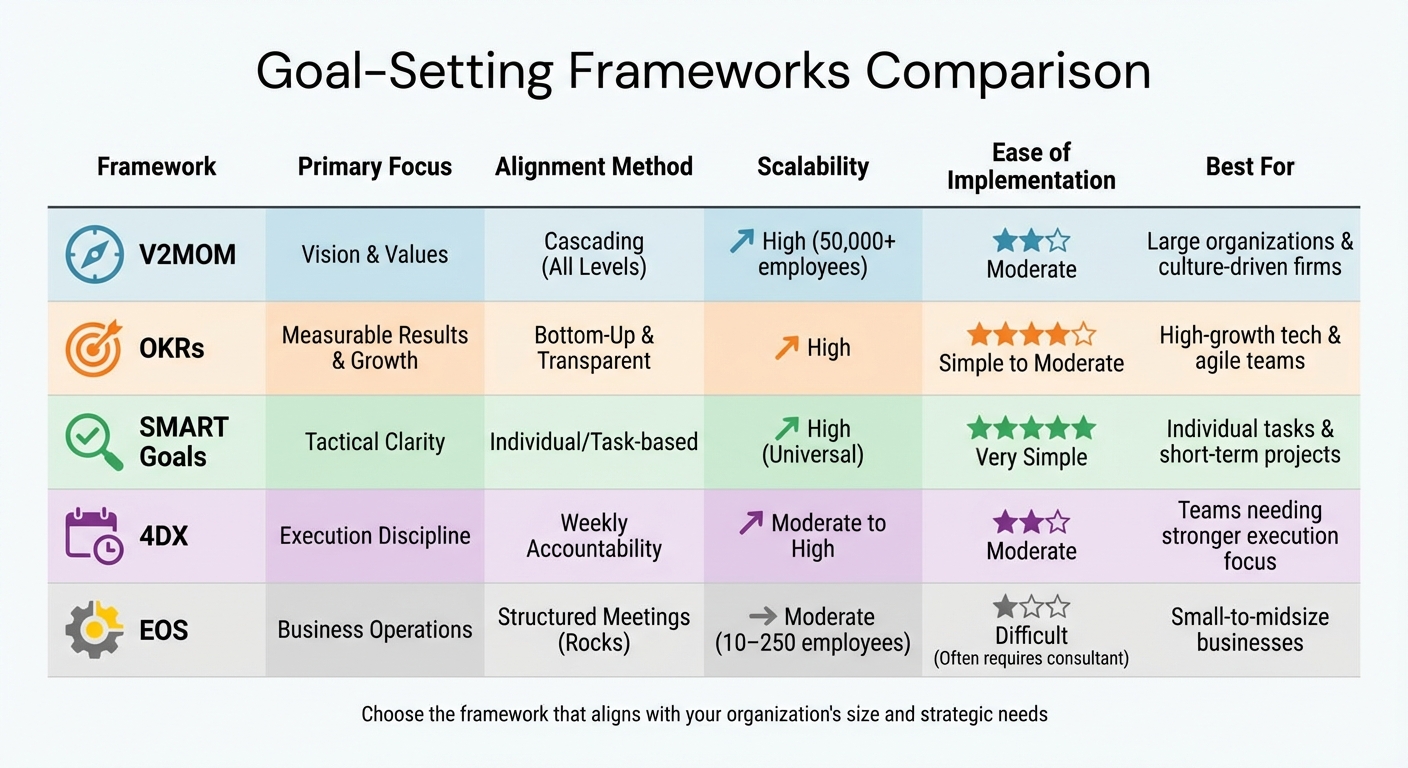
When you stack up V2MOM, OKRs, SMART Goals, 4DX, and EOS, it becomes clear that each framework is tailored to tackle specific organizational challenges. Take V2MOM, for instance – its vision-first approach and ability to scale are key reasons Salesforce successfully aligns its massive 50,000-strong workforce. Let’s break down what makes each framework tick and where they shine.
Unlike V2MOM’s vision-driven strategy, OKRs thrive in fast-moving environments, especially in tech, thanks to their agile, frequent review cycles [4]. On the other hand, SMART Goals are all about keeping things straightforward, making them ideal for individual tasks or short-term objectives. Then you have 4DX, which focuses on disciplined execution with weekly accountability, helping teams stay on track [8][16]. EOS, meanwhile, serves as a full-fledged operating system for businesses, complete with a structured meeting rhythm. It’s particularly suited for companies with 10 to 250 employees, often with guidance from an external consultant [4].
Each framework has its strengths, and understanding these nuances is crucial for fostering effective collaboration. The table below highlights the core differences to help align strategies with your business needs:
| Framework | Primary Focus | Alignment Method | Scalability | Ease of Implementation | Best For |
|---|---|---|---|---|---|
| V2MOM | Vision & Values | Cascading (All Levels) | High (50,000+ employees) | Moderate | Large organizations & culture-driven firms |
| OKRs | Measurable Results & Growth | Bottom-Up & Transparent | High | Simple to Moderate | High-growth tech & agile teams |
| SMART Goals | Tactical Clarity | Individual/Task-based | High (Universal) | Very Simple | Individual tasks & short-term projects |
| 4DX | Execution Discipline | Weekly Accountability | Moderate to High | Moderate | Teams needing stronger execution focus |
| EOS | Business Operations | Structured Meetings (Rocks) | Moderate (10–250 employees) | Difficult (Often requires consultant) | Small-to-midsize businesses |
What sets V2MOM apart is its inclusion of "Obstacles" as a key component, encouraging teams to anticipate and address challenges early on [1]. Its scalability – from startups to global enterprises – combined with its focus on long-term vision and cultural alignment, makes it a standout choice for organizations looking to build a cohesive and forward-thinking strategy.
Why V2MOM Works Best for Team Collaboration
How V2MOM Benefits Teams
When it comes to fostering team collaboration, V2MOM stands out. Unlike OKRs, which emphasize metrics, or SMART Goals, which focus on individual tasks, V2MOM takes a broader approach by incorporating vision, values, and obstacles into the framework. This ensures teams are not only clear on what they need to achieve but also aligned on how to work together and prepared for potential challenges.
The results speak for themselves. At Salesforce, 95% of employees are aligned with the company's goals [5]. Compare this to the mere 7% of employees in most organizations who fully understand their company’s strategy [6]. That’s the difference between a framework that sits unused in a document and one that actively shapes daily work.
"V2MOM is an iterative, transparent, and feedback-driven process. Everyone has a chance to provide input and feedback which creates buy-in, alignment, transparency, and unity across the organization." – Salesforce [6]
Transparency is a cornerstone of V2MOM. By giving employees visibility into goals and progress, the framework fosters accountability and promotes cross-team understanding [6][13]. Additionally, by identifying obstacles early on, teams can address risks proactively, paving the way for smoother collaboration and problem-solving [1].
This strong foundation of alignment and transparency makes V2MOM an ideal framework for digital tools like V2MOM.io, which further simplifies and enhances the process.
How V2MOM.io Simplifies Goal-Setting
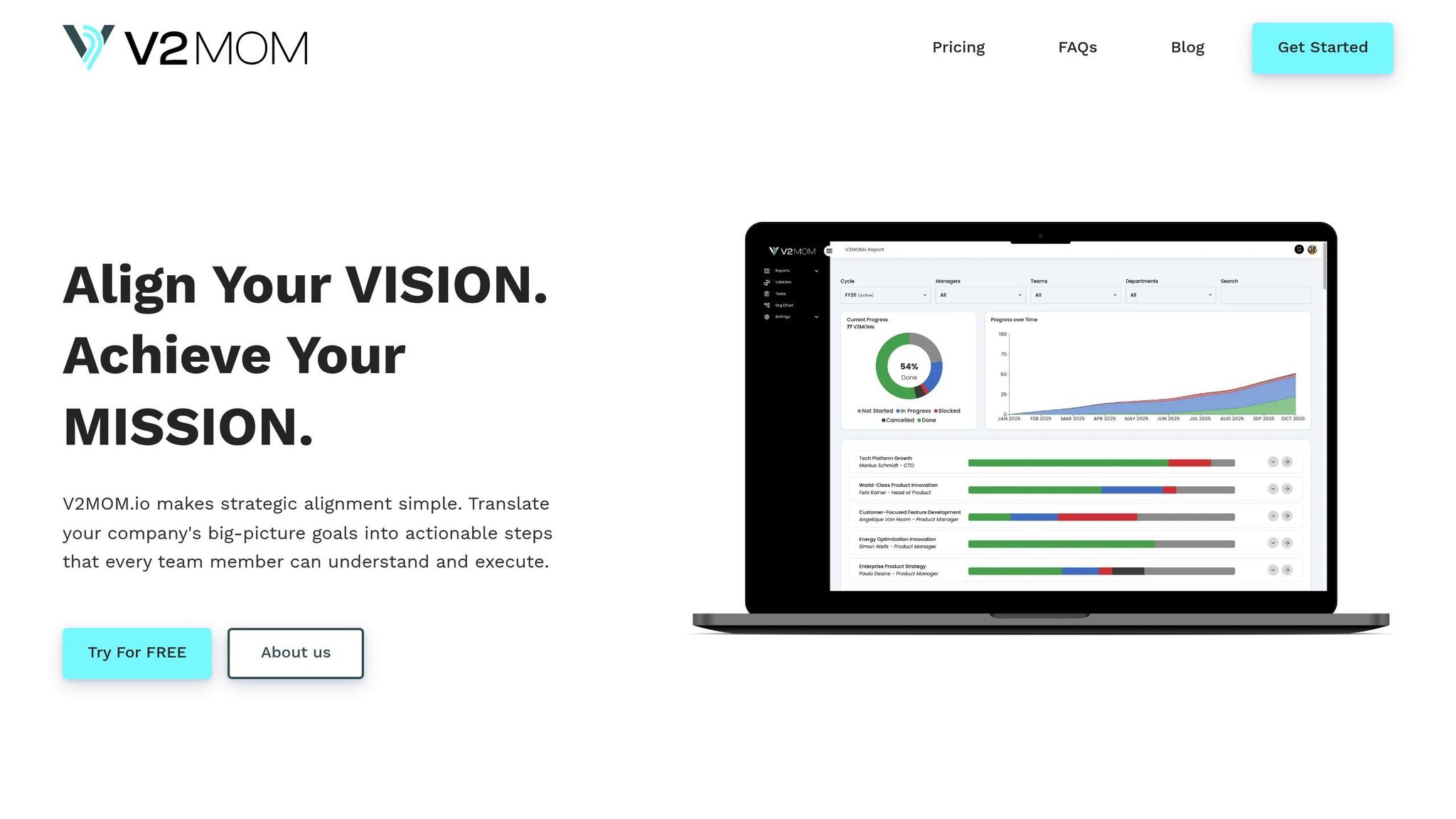
V2MOM.io takes the framework from static documents to a dynamic, centralized platform, revolutionizing how teams set and track goals. By integrating the five core components - Vision, Values, Methods, Obstacles, and Measures - into a single system, V2MOM.io eliminates the need for outdated spreadsheets and templates. Teams now have a single, always-updated source of truth.
One of the biggest challenges with any goal-setting framework is follow-through. V2MOM.io addresses this with real-time progress tracking, data-driven insights, and collaborative tools. Updating goals becomes quick and intuitive, saving time and mental energy. Teams can monitor their Measures, adapt their Methods as situations evolve, and stay aligned without unnecessary complexity. This digital shift strengthens V2MOM’s role as a strategic tool for company-wide cohesion.
Whether you’re a small startup or a large enterprise managing tens of thousands of employees, V2MOM.io scales effortlessly. The platform offers a free Starter plan for up to 10 users and 3 teams, while the Business plan provides unlimited users and teams for $5.99 per user per month (billed annually). It’s designed with the user in mind, prioritizing ease of use over flashy features.
Conclusion
V2MOM’s integrated approach ensures that every team member plays a direct role in achieving the company’s vision. By treating goal-setting as a collaborative and dynamic process, it goes beyond metrics or individual tasks to connect daily work with long-term objectives. It also lays the groundwork for a shared sense of purpose and teamwork.
"The magic of the V2MOM is its simplicity. It's easy to digest, understand, and implement. And best of all, every employee in the company has one, making it easy for everyone to know how they contribute to the company's success." – Salesforce [6]
For businesses seeking alignment at every level, V2MOM offers a scalable, practical approach that keeps teams focused on what truly matters as they grow. With tools like V2MOM.io, it’s easier than ever to turn this framework into a driving force for success.
FAQs
How does V2MOM help large organizations align their culture across teams?
V2MOM integrates Values into every plan, ensuring they remain central to how teams operate. By defining the principles that guide their work and linking them directly to the organization’s overarching Vision, teams create a shared foundation that shapes decisions and behaviors at every level.
In larger organizations, this framework flows from leadership down through each department. Every level tailors the Vision and Values into their own Methods, Obstacles, and Measures, creating a structured system that keeps the culture consistent across daily operations. Tools like V2MOM.io make this process even smoother by enabling teams to update, track, and collaborate on shared values in real time, helping maintain a cohesive and aligned culture throughout the company.
How does V2MOM differ from OKRs?
V2MOM and OKRs take different approaches to goal-setting, each offering unique strengths. V2MOM is a structured framework built around five elements: Vision, Values, Methods, Obstacles, and Measures. It goes beyond defining goals by also outlining how to achieve them, addressing priorities and potential hurdles along the way.
In contrast, OKRs (Objectives and Key Results) are more straightforward, focusing on setting clear objectives and measurable results. OKRs are designed for flexibility and speed, making them ideal for fast-moving environments. However, they don't explicitly incorporate values or obstacles into their process.
For teams looking to implement V2MOM effectively, platforms like V2MOM.io provide tools to track progress, collaborate in real time, and ensure alignment across all five components of the framework.
Can V2MOM work with other goal-setting frameworks like SMART Goals?
Yes, V2MOM works well alongside other goal-setting frameworks like SMART Goals. V2MOM lays out a broad structure by focusing on Vision, Values, Methods, Obstacles, and Measures, while SMART Goals bring precision to the Measures by ensuring they are Specific, Measurable, Achievable, Relevant, and Time-bound.
This combination allows organizations to balance big-picture thinking with actionable details. By integrating these approaches, teams can connect strategic goals to measurable outcomes, making it easier to track progress and improve collaboration.