Struggling to align your team with your organization’s goals? Here’s the solution: V2MOM. This simple framework - Vision, Values, Methods, Obstacles, and Measures - helps leaders turn strategies into actionable steps while keeping everyone on the same page. Created by Salesforce’s Marc Benioff, it’s been key to their growth from a 4-person startup to a global company with 75,000+ employees.
Why It Works:
- Clarity: Everyone knows the goal (Vision) and why it matters (Values).
- Actionable Steps: Outlines how to achieve goals (Methods) and address challenges (Obstacles).
- Accountability: Tracks progress with measurable outcomes (Measures).
Salesforce’s success shows how V2MOM fosters alignment, transparency, and purpose across all levels. Ready to implement it? Start by creating a one-page plan for your leadership team, cascade it to departments, and track progress regularly. Tools like V2MOM.io simplify this process, ensuring your team stays focused and aligned.
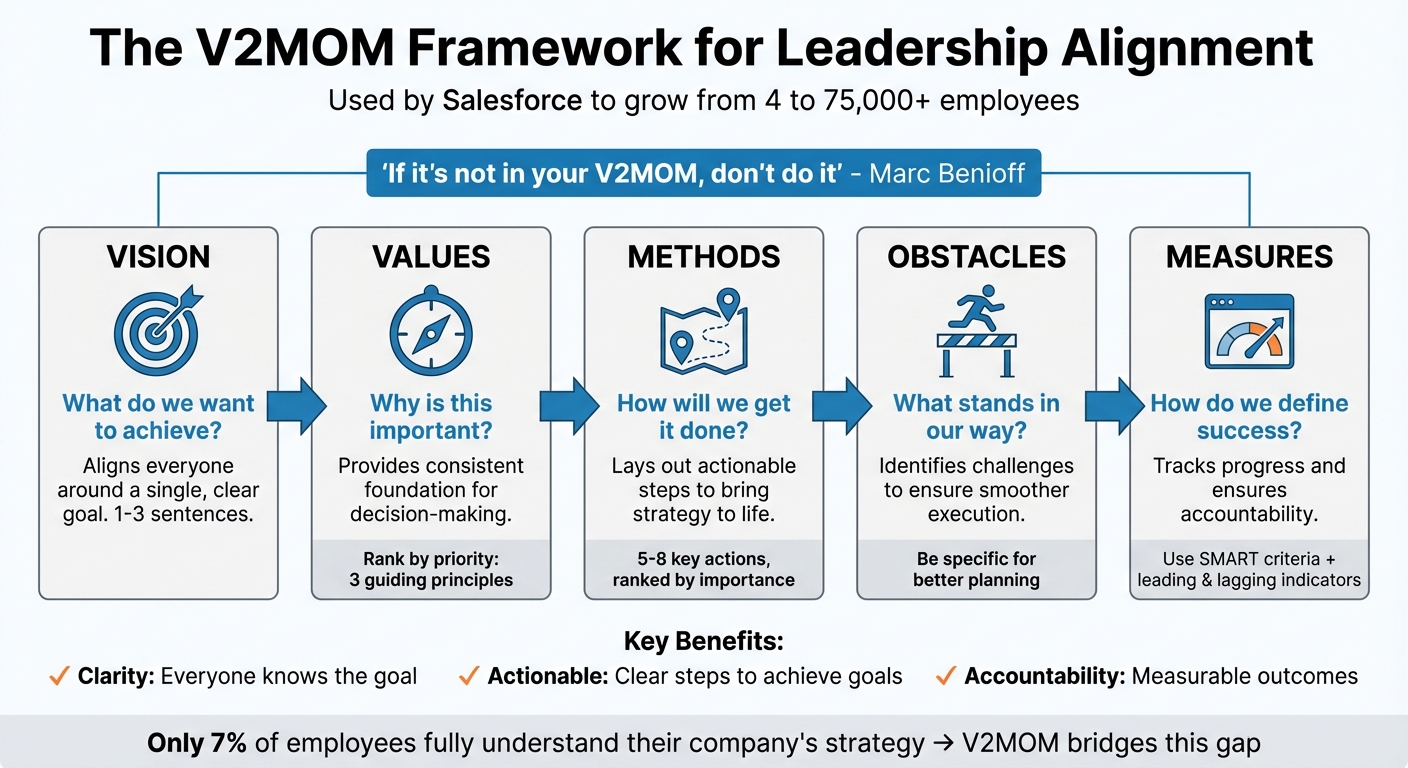
V2MOM Framework: 5 Components for Leadership Alignment
👉 “V2MOM Framework Explained | The Salesforce Strategy Behind 10x Company Growth 🚀”
Understanding the V2MOM Framework
The V2MOM framework simplifies strategic planning into five essential components. By breaking strategy into these parts, it creates a bridge between leadership goals and actionable tactics. When leadership teams work through these systematically, they create a shared understanding that removes confusion and keeps everyone aligned toward the same objectives.
| Component | Key Question Addressed | Contribution to Alignment |
|---|---|---|
| Vision | What do we want to achieve? | Aligns everyone around a single, clear goal. |
| Values | Why is this important? | Provides a consistent foundation for decision-making. |
| Methods | How will we get it done? | Lays out actionable steps to bring the strategy to life. |
| Obstacles | What stands in our way? | Identifies challenges to ensure smoother execution. |
| Measures | How do we define success? | Tracks progress and ensures accountability. |
Each of these components plays a role in fostering alignment, as explored in the following sections.
Vision: Defining the End Goal
The vision component answers the big question: What do we want to achieve? It focuses on a single, clear outcome that defines success. A concise vision statement (just 1–3 sentences) can inspire and guide action.
Take President John F. Kennedy's vision for NASA in 1961: "This nation should commit itself to achieving the goal, before this decade is out, of landing a man on the moon and returning him safely to the earth." This bold statement rallied thousands of people and countless resources, leading to the moon landing in 1969 [4].
Similarly, Salesforce's founders, including Marc Benioff, drafted their first V2MOM on the back of an American Express envelope. Their vision? To "rapidly create a world-class Internet company/site for Sales Force Automation." This clarity set the stage for their rise as a leader in the software-as-a-service industry.
A strong vision eliminates uncertainty, accelerates decisions, and ensures every team member is working toward the same goal.
Values: Guiding Decision-Making
Values answer the question, Why is this important? They establish the principles that guide an organization’s actions and decisions as it pursues its vision. But values aren’t just feel-good phrases - they serve as practical tools for navigating tough choices.
For example, during a product tampering crisis, Johnson & Johnson relied on its core value of "customer safety" to make a tough call: pulling Tylenol from shelves. This decision cost the company $100 million but reinforced trust and stayed true to their guiding principles.
Ranking values by priority is crucial. Without prioritization, it becomes unclear which values should guide decisions in moments of conflict.
Methods: Turning Vision into Action
Methods tackle the practical question: How will we get it done? They translate the vision into actionable steps by outlining specific initiatives that bridge the gap between where you are and where you want to go.
Using SMART criteria - Specific, Measurable, Achievable, Relevant, and Time-bound - can help create effective methods. For instance, Salesforce's early V2MOM outlined concrete actions like team hiring, rapid product development, and forming key partnerships. These steps were critical to their success.
Marc Benioff, Salesforce’s CEO, famously said, "If it is not in your V2MOM, don't do it." [6] This approach ensures teams stay focused on what matters most.
Obstacles: Identifying Challenges
Obstacles force leaders to ask, What stands in our way? This step involves a candid look at the internal and external barriers that could derail progress. By pinpointing these challenges early, teams can allocate resources wisely and craft strategies to navigate around them.
When President Kennedy set the moon landing goal, he acknowledged the technical and financial hurdles ahead. This awareness drove innovative solutions and resource allocation.
Be as specific as possible when identifying obstacles. Specificity allows for better planning and ensures that potential roadblocks don’t derail progress.
Measures: Tracking Success
Measures address the critical question: How will we know we’re successful? They provide clear, quantifiable criteria for evaluating progress and holding teams accountable.
As Salesforce Trailhead puts it, "If you're not able to measure it, you probably don't understand what you are trying to achieve." [4] Effective measures focus on outcomes, not just activities. For example, instead of a vague goal like "improve customer satisfaction", set a clear target like "achieve a 75% open rate" or "launch the new blog by Q4."
Incorporating both lagging indicators (like revenue) and leading indicators (like customer engagement) gives a well-rounded view of progress. When employees are aligned and focused on measurable goals, the impact on business performance can be significant [3] [5].
Clear measures not only track success but also create transparency, allowing teams to adjust strategies as needed.
How to Create and Cascade a Leadership V2MOM
Building a leadership V2MOM begins at the very top. The CEO collaborates with their direct reports to draft the corporate V2MOM, which serves as the blueprint for aligning the entire organization [3]. Before finalizing, it’s crucial to gather feedback through focus groups and company-wide meetings. This iterative process not only improves the document but also fosters transparency and employee buy-in from the outset [3][5]. By starting with a clear, top-down approach, leaders set the tone for directives that resonate across all teams.
Designing a Leadership V2MOM
Crafting a leadership V2MOM involves working through its five core components in a specific order. For leadership teams, the emphasis should be on strategic priorities, with actionable details supporting each element. Here’s how to approach it:
- Vision: Begin with a bold, concise statement - just 1 to 3 sentences - that captures what you aim to achieve [4]. It should be both clear and inspiring.
- Values: Identify three guiding principles that will shape decision-making and help teams navigate trade-offs [4]. Prioritize these values to clarify which takes precedence in challenging situations.
- Methods: Outline 5 to 8 key actions needed to achieve the vision, ranked by importance [4]. This prioritization helps guide resource allocation effectively.
- Obstacles: Pinpoint specific challenges and propose practical solutions [4]. Vague obstacles often lead to equally vague solutions, so clarity here is essential.
- Measures: Use SMART criteria (Specific, Measurable, Achievable, Relevant, Timely) to define success [4]. Include both "Progress Measures" (quantifiable targets) and "Completion Measures" (milestones that indicate task completion).
Keep the document to a single page to ensure clarity and focus. Marc Benioff, Founder and CEO of Salesforce, highlights the importance of this approach:
"Success depends on constant communication and complete alignment – we've been able to achieve this through V2MOM." [2]
This alignment begins with a well-structured leadership V2MOM, setting the stage for cascading the strategy throughout the organization.
Cascading V2MOM Across Teams
Once the corporate V2MOM is established, it filters down to departments, teams, and individuals. Each group creates its own V2MOM that aligns with the overarching corporate goals [3]. Leadership plays a key role in ensuring this cascading process maintains strategic consistency and clarity across all levels [1].
At Salesforce, where V2MOM aligns over 75,000 employees, the process is highly structured. After Benioff shares the corporate V2MOM on Chatter (accessible to all employees), teams have 90 days to create their aligned versions [3][4]. This timeframe allows both new hires and current employees to familiarize themselves with the company’s strategic landscape before committing to their own objectives [4].
Transparency is a cornerstone of this process. By making every employee’s V2MOM visible within the organization, individuals can see how their efforts contribute to the broader vision [3][4]. Sharing drafts with peers before finalizing also helps teams identify cross-functional dependencies - for example, where one team’s obstacle might align with another’s method [4].
Integrating V2MOM into Planning Cycles
A V2MOM isn’t a static document; it’s a dynamic tool that shapes ongoing discussions and daily decisions [3]. Each year, a new corporate V2MOM is created to guide the organization’s focus, but regular reviews - monthly or quarterly - are essential to track progress against measures and adjust methods as obstacles evolve.
These reviews ensure that leadership’s vision remains front and center while keeping teams aligned with the company’s strategic goals. Employees should also update their V2MOM whenever their role changes, ensuring their objectives remain relevant to their new responsibilities.
Centralized platforms make this process more efficient by providing real-time access to the strategy for all stakeholders. Tools like V2MOM.io (https://v2mom.io) offer features for creating, cascading, and monitoring V2MOMs, complete with progress tracking and collaborative tools.
Consider this: only 7% of employees fully understand their company’s business strategies and their role in achieving them [3][5]. Regular reviews and transparent communication through the V2MOM framework help bridge this gap, ensuring that strategic priorities remain top of mind throughout the year.
sbb-itb-ee93501
Leadership Practices for Maintaining Alignment
Creating a V2MOM is only the start; the real challenge lies in keeping it relevant and impactful. Without consistent effort, even the most well-thought-out V2MOM risks becoming just another forgotten document. What sets successful organizations apart is how leaders approach the framework - not as a one-time task but as an active system that informs daily decisions and guides conversations.
Making V2MOM a Living System
To truly work, the V2MOM framework needs ongoing attention. As Salesforce Trailhead aptly describes it:
"The V2MOM is a living, breathing document. And it gets very grumpy if you don't feed it and take care of it regularly." [7]
Regular check-ins with team members are crucial. Ask questions like: "Do your current projects align with your Methods?", "What changes are needed to reflect current priorities?", and "What support do you need to tackle Obstacles?" [7]. These discussions ensure the V2MOM evolves alongside business realities.
Set a rhythm for reviews - quarterly progress updates during team meetings and a mid-year refresh to adjust for shifting priorities [4, 13]. Use the framework as a filter for decision-making. For example, if a new initiative doesn’t align with your Methods, it’s worth questioning whether it should receive resources or be set aside to maintain focus [2].
Leaders can also encourage employees to personalize their V2MOMs rather than simply copying their manager’s version. This approach fosters ownership and allows individuals to include areas like personal growth or wellness in their Methods [7].
Technology can make this process even smoother, turning the V2MOM into an active alignment tool.
Using Technology to Streamline V2MOM
Technology can transform the V2MOM from a static document into a dynamic, organization-wide system. Salesforce exemplifies this by providing employees with searchable access to strategic priorities, ensuring that 95% of its workforce understands how their work ties into the company’s success - a remarkable contrast to the 7% alignment rate seen in many organizations [5, 13].
For companies aiming to replicate this level of clarity, tools like V2MOM.io (https://v2mom.io) offer a tailored platform for the framework. It centralizes vision, values, methods, obstacles, and measures, while offering features like real-time progress tracking, team collaboration, and data-driven insights. The platform simplifies cascading V2MOMs from leadership to individual contributors, tracking progress, and identifying cross-functional dependencies - all without the hassle of manual updates or spreadsheets.
By automating updates and providing instant visibility, the right technology fosters accountability and helps leaders identify misalignment before it escalates. This kind of streamlined system ensures that alignment is monitored and maintained daily.
Examples of Aligned Leadership Behaviors
Beyond systems and tools, leadership behaviors are critical for reinforcing alignment. It’s not just about having a framework - it’s about how leaders embody and communicate it. Transparency is a cornerstone. At Salesforce, for instance, CEO Marc Benioff shares his own V2MOM publicly, alongside those of all employees, demonstrating that alignment starts at the top [5, 13].
Consistent communication strengthens this alignment further. Structuring major meetings - like Town Halls or Quarterly Business Reviews - around the V2MOM framework keeps strategic priorities front and center. Leaders should also treat the V2MOM as an evolving conversation. When business conditions shift, openly revising Methods or Obstacles ensures the framework remains relevant and actionable.
Accountability is another key factor. At Salesforce, every employee is required to create and publish their V2MOM on time, embedding the framework into the company’s culture [7]. By treating the V2MOM as a must-have while staying open to updates, leaders create an environment where alignment becomes second nature across the organization.
Conclusion
Key Takeaways
The V2MOM framework takes the often abstract idea of leadership alignment and turns it into something practical and actionable. It ensures that everyone in your organization - from top executives to team members - knows the company’s goals and how their individual contributions fit into the bigger picture. This helps solve a common problem: many employees don’t fully understand their company’s strategy or their role in achieving it.
What sets V2MOM apart is its straightforward design and ability to scale. Salesforce leveraged this framework to grow from a small four-person startup into a company with over 75,000 employees[2], adding $100 billion in market value in just a decade[8]. A guiding principle of the framework is simple yet powerful: “If it’s not in your V2MOM, don’t do it”[6]. This focus helps eliminate wasted effort and keeps teams aligned on what matters most.
The five components of V2MOM - Vision, Values, Methods, Obstacles, and Measures - promote transparency and accountability. By addressing potential roadblocks early and tracking progress through specific metrics, leaders can proactively tackle challenges before they become major setbacks. When treated as a dynamic system with regular updates and supported by technology, V2MOM becomes an essential tool for keeping your organization aligned and on track.
Next Steps
Ready to put V2MOM into action? Here’s how to get started.
First, develop your leadership V2MOM. Define your Vision, Values, Methods, Obstacles, and Measures through focused planning sessions. Share your draft with your team to gather feedback, build alignment, and uncover any gaps you might have missed.
Next, roll out the framework across your organization. Each department - and even individual team members - should create their own V2MOM that connects back to the overall strategy. This ensures that everyone understands how their daily tasks support the company’s broader goals.
To make the process even smoother, consider using V2MOM.io (https://v2mom.io). This platform centralizes all aspects of your V2MOM, offering tools for real-time tracking, team collaboration, and data analysis. It eliminates the hassle of managing the framework manually and helps keep your V2MOM active and relevant throughout the year.
FAQs
What is the best way to implement the V2MOM framework in my organization?
To put the V2MOM framework into practice, start with a clear Vision. This should be a short, motivating statement that captures your organization's ultimate objective. Follow up by identifying 3-5 core Values - principles that will guide decisions and shape the organization's culture. With the vision in mind, outline the actionable Methods needed to achieve it, assigning specific tasks, owners, and realistic timelines.
Anticipate potential Obstacles that could arise and prepare strategies to address them, ensuring smoother execution along the way. To measure progress effectively, establish SMART Measures - these are metrics that are specific, measurable, attainable, relevant, and time-bound. Keeping everything organized is key, so consider using a centralized platform like V2MOM.io. This can help streamline collaboration, provide real-time progress updates, and ensure everyone stays on the same page.
Lastly, make it a habit to review and adjust your V2MOM regularly, such as during quarterly check-ins. This ensures the framework stays relevant and effective, turning strategic plans into actionable results while keeping teams aligned and focused.
What challenges might organizations face when using the V2MOM framework, and how can they overcome them?
Organizations that use the V2MOM framework often face a few common hurdles. One major challenge lies in crafting a clear Vision and defining specific Values. Without these, teams can lose sight of the purpose behind the plan, leading to confusion, misalignment, and disengagement. Another obstacle arises when trying to scale the framework in larger organizations, where coordinating multiple stakeholders and juggling priorities can become overwhelming. Lastly, poorly defined or vague Measures can make tracking progress difficult, leading to delays and missed challenges.
To tackle these issues, start by developing a concise and motivating Vision paired with a focused set of Values that resonate across the organization. Break down Methods into actionable steps, assign clear ownership, and set realistic timelines for each task. Regular progress reviews - quarterly ones work well - can help identify and address any emerging obstacles. Make sure your Measures follow the SMART criteria (specific, measurable, attainable, relevant, time-bound) to ensure progress is both visible and actionable. Tools like V2MOM.io can also be a game-changer, providing a centralized space to organize these components, encourage collaboration, and turn potential challenges into manageable tasks. This keeps everyone aligned and moving toward the shared Vision.
How does the V2MOM framework improve team accountability and transparency?
The V2MOM framework strengthens accountability by assigning clear ownership for each Method and connecting every action to measurable Measures. This approach ensures team members understand exactly what they need to accomplish and the deadlines for doing so. With specific responsibilities and timelines tied to each task, progress becomes more structured and predictable. The Measures - such as revenue targets or key milestone dates - act as concrete checkpoints, making it easier to track and evaluate progress along the way.
Transparency is a key benefit of V2MOM, as it consolidates the Vision, Values, Methods, Obstacles, and Measures into a single, centralized document that everyone in the organization can access. This shared framework gives every team member a clear view of the company’s goals and how their individual contributions fit into the bigger picture. Regular reviews ensure progress remains visible, providing opportunities to celebrate wins, tackle roadblocks, and keep teams aligned with the overarching strategy.