Values guide every decision teams make, from daily tasks to high-stakes challenges. They influence collaboration, performance, and how conflicts are resolved. Shared values like trust and honesty create stronger bonds and faster decisions, while conflicting values can lead to inefficiency and disagreements. Leaders play a key role in aligning team values, which directly impact outcomes.
Key takeaways:
- Values drive decisions: They balance short-term needs with long-term goals.
- Leadership matters: A leader’s focus on achievement boosts team performance.
- Shared values reduce conflict: Teams with aligned values work more efficiently.
- Tools help track alignment: Platforms like V2MOM.io connect values to measurable outcomes.
From Johnson & Johnson’s Tylenol recall to Parker Hannifin’s pricing shift, values-driven decisions lead to lasting success. The challenge? Turning abstract values into daily practices. Using frameworks and tools ensures teams stay aligned and achieve better results.
Research Findings: How Values Affect Team Dynamics
Evidence on Values and Leadership
The values held by leaders play a critical role in shaping team performance. Research involving 48 teams revealed that a leader's focus on achievement has a stronger impact on team success than the values held by other team members [1]. Leaders who emphasize socially recognized accomplishments tend to inspire higher levels of overall team performance.
The way a leader approaches their role also determines whether differing values within the team lead to conflict. Leaders with a task-oriented approach reduce conflict by prioritizing organizational rules over personal beliefs. On the other hand, leaders who adopt a more person-focused style may unintentionally heighten conflict by giving more weight to individual viewpoints [4].
"The achievement values of the team leader impacted performance above and beyond the influence of other team members' values."
- Laura Parks-Leduc, Professor, James Madison University [1]
These leadership styles create the foundation for how shared or differing values among team members influence conflict resolution within the group.
Values and Conflict Resolution
Building on the impact of leadership, shared values among team members significantly enhance cohesion and simplify conflict resolution. Teams with similar core values tend to experience stronger bonds, greater efficiency, and far fewer disagreements [5]. In contrast, when team members hold diverse or conflicting values, disagreements over work practices can arise, making it harder to reach consensus and coordinate tasks effectively [4]. Teams with a mix of differing or "hybrid" values often struggle to perform as well as those with a more unified value system [3].
Values-Based Decision-Making | Vince Lombardo and Josh Linkner
How Values Shape Team Decisions
How Cultural Dimensions Impact Team Decision-Making and Performance
Values and Peer Influence
Values play a significant role in shaping not just individual choices but also how teams influence one another, especially in uncertain situations. When people are unsure about the best course of action, they often look to their peers for direction, and this influence can be surprisingly strong.
Take, for example, a five-year study examining 5 million births in Brazil. Researchers Jillian Chown from the Kellogg School of Management and Carlos Inoue from the Gies College of Business discovered a striking pattern: for every 0.06 increase in a colleague's tendency to perform C-sections, a physician's own likelihood of opting for the procedure rose by one percentage point. This ripple effect translated into 53,000 additional C-sections during the study period [7].
"The idea that expert decision-making is malleable is somewhat disconcerting." - Jillian Chown, Associate Professor of Management & Organizations, Kellogg School of Management [7]
The study also revealed that peer influence becomes even more pronounced in certain scenarios. It was found to be 73% stronger when team members engaged in varied tasks and 95% stronger when tasks were closely related [7].
Interestingly, the perception of integrity among leaders has a far greater impact than any formal declaration of values. Research shows that when employees view top managers as ethical and trustworthy, both team and organizational performance see noticeable improvements [6]. On the other hand, corporate values statements alone rarely lead to meaningful change [6].
These dynamics of peer influence and perceived integrity are further shaped by broader cultural factors, which significantly affect decision-making within teams.
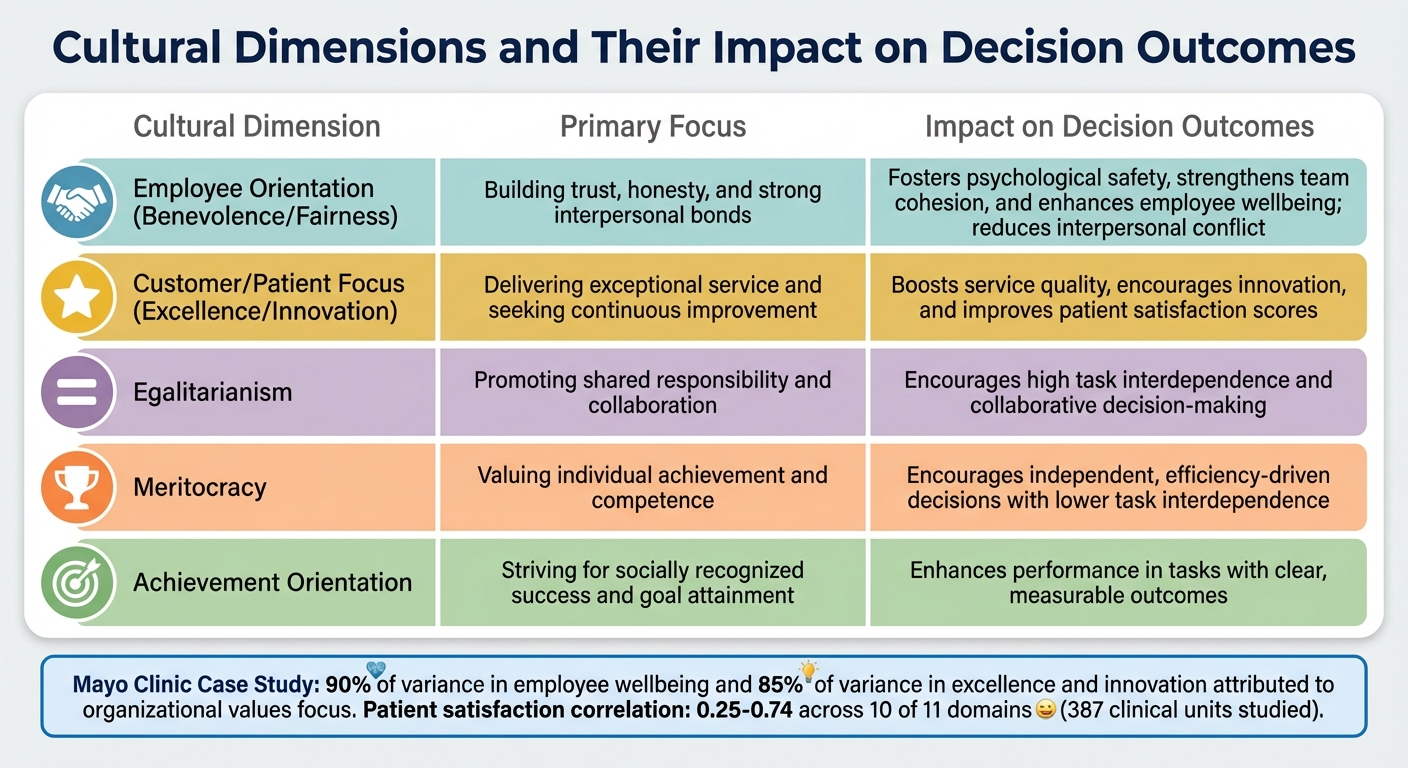
Cultural Dimensions and Decision Outcomes
Cultural dimensions act as a lens through which shared values influence team decisions, tailoring approaches to fit different contexts.
| Cultural Dimension | Primary Focus | Impact on Decision Outcomes |
|---|---|---|
| Employee Orientation (Benevolence/Fairness) | Building trust, honesty, and strong interpersonal bonds | Fosters psychological safety, strengthens team cohesion, and enhances employee wellbeing; reduces interpersonal conflict [1][8][9] |
| Customer/Patient Focus (Excellence/Innovation) | Delivering exceptional service and seeking continuous improvement | Boosts service quality, encourages innovation, and improves patient satisfaction scores [8][9] |
| Egalitarianism | Promoting shared responsibility and collaboration | Encourages high task interdependence and collaborative decision-making [3] |
| Meritocracy | Valuing individual achievement and competence | Encourages independent, efficiency-driven decisions with lower task interdependence [3] |
| Achievement Orientation | Striving for socially recognized success and goal attainment | Enhances performance in tasks with clear, measurable outcomes [1] |
Teams that embrace egalitarian values often develop highly interdependent work structures, relying on frequent collaboration and social interaction. In contrast, meritocratic teams lean toward independent work styles, focusing on efficiency and individual contributions. However, teams with mixed or conflicting value systems tend to struggle, often underperforming compared to those with a unified set of values [3].
A case in point is Mayo Clinic Health Systems. A November 2018 study across 387 clinical units highlighted that an organizational focus on values like "Excellence and Innovation" had a strong positive correlation (0.25–0.74) with patient satisfaction scores in 10 out of 11 measured domains. The study also revealed that 90% of the variance in employee wellbeing and 85% of the variance in excellence and innovation could be attributed to the organization’s commitment to these values [8].
sbb-itb-ee93501
Applying Values in Team Processes
Connecting Values to Measurable Outcomes
Turning abstract values into measurable outcomes requires a clear and structured approach. The Decision Mapping Framework simplifies this process by breaking decisions into four key stages: choice options, short-term consequences, long-term outcomes, and the values or goals driving the decision. This framework helps teams uncover the trade-offs they navigate daily, making implicit priorities more visible and actionable [2].
A great example of this in action is the Tylenol crisis. Johnson & Johnson relied on a strong pre-existing value framework to make quick, unified decisions during a challenging time. Their ability to act swiftly and consistently was rooted in their commitment to core values [2].
"All decisions - whether judged highly ethical, grossly unethical or anywhere in between - are values-based. That is, a decision necessarily involves an implicit or explicit trade-off of values." - Joel E. Urbany, Professor of Marketing, University of Notre Dame [2]
Leaders can further strengthen this connection by reviewing decisions with their teams to identify the values behind each choice. This practice helps transform abstract ideals into clear, actionable patterns that guide future decision-making. For instance, Parker Hannifin Corp’s move from cost-based to value-based pricing significantly boosted financial performance by aligning their pricing strategy with their broader strategic values [2].
Measuring values can also vary depending on the task. For additive tasks, where every team member’s input matters (such as building team cohesion), teams can calculate an average score for values like benevolence. On the other hand, for disjunctive tasks, where success depends on one standout performer, focusing on the highest individual score can highlight team members with strong achievement values who are best suited to lead critical efforts. Research involving 48 teams showed a direct link between team member values - like benevolence and achievement - and overall team performance [1].
To maintain these measurable outcomes, teams need tools that embed values into their daily workflows.
Using Tools for Alignment
Defining and measuring values is only the first step. To ensure they remain central to daily operations, teams need a system that keeps these values visible and actionable. Centralized platforms offer a practical solution. For example, V2MOM.io (https://v2mom.io) provides a dedicated space for teams to document their vision, values, methods, obstacles, and measures all in one place. With real-time progress tracking and collaboration features, the platform ensures strategic alignment stays front and center.
By integrating values with specific methods and measurable outcomes, V2MOM.io fosters accountability and builds trust between team members and leaders. The platform’s ease of use - updates can be made in minutes - makes it a sustainable tool for maintaining alignment throughout the year.
For organizations juggling multiple tools and scattered information, V2MOM.io acts as a unified source of truth. Teams across marketing, product, operations, and leadership can access the same data, ensuring decisions reflect shared values rather than isolated departmental goals. Additionally, the platform’s built-in analytics provide insights into how well teams are adhering to their stated values, helping identify and address misalignments before they affect performance.
Conclusion: How Values Drive Team Success
Key Takeaways
Values are the foundation of every team’s decision-making process. Research highlights that benevolence promotes teamwork and harmony, while achievement propels performance [1]. For tasks focused on relationships, a team rich in benevolence thrives; for performance-oriented goals, even one high-achieving individual can make a significant difference [1]. These insights show how values directly influence team dynamics and outcomes, paving the way for practical application.
Incorporating values into decision-making doesn’t have to be complicated. Tools like decision mapping allow teams to clearly outline options, consequences, and the values tied to each choice. This makes trade-offs easier to identify and act upon [2]. History has shown that value-driven decisions can lead to remarkable results, especially during critical moments like organizational crises or major strategy shifts [2].
Leadership plays a crucial role in embedding values into daily operations. Structured decision-making frameworks, such as those offered by V2MOM.io, help leaders formalize the process. By fostering clear communication and reducing friction caused by differing values, task-focused leadership ensures smoother collaboration. Teams that align their values tend to report higher satisfaction, stronger commitment, and better results overall [1][2][4].
For lasting success, it’s vital to make values measurable and integrate them into daily workflows. Tools like V2MOM.io centralize vision, values, methods, obstacles, and metrics, keeping strategic alignment at the forefront. By tying everyday decisions to core values and using real-time feedback, teams can ensure alignment isn’t just an annual goal. When values are seamlessly woven into daily practices, they become the backbone of better collaboration, smarter decisions, and stronger performance.
FAQs
How do shared values improve decision-making in teams?
Shared values act as a guiding compass for teams, providing a unified foundation for decision-making. When team members are aligned on what truly matters, they can better interpret information, weigh options, and even anticipate each other’s preferences. This alignment cuts down on lengthy debates and helps avoid unnecessary conflicts. The result? Teams build trust, spark creativity, and boost overall performance.
Teams that prioritize shared values also tend to collaborate more effectively. For instance, groups that value equality often lean toward open, interconnected problem-solving methods. On the flip side, teams with conflicting values can struggle with fragmented decisions. By weaving shared values into everyday choices - like prioritizing ethics over short-term wins - teams ensure their decisions remain both principled and strategically aligned.
Tools like V2MOM.io make it easier to put these values into practice. By integrating values with vision, methods, obstacles, and measures, platforms like this provide a clear framework to guide decisions and keep everyone working toward common goals.
How do leaders help align team values with decision-making?
Leaders are essential in transforming organizational values into practical, everyday actions for their teams. By clearly defining these values and consistently embodying them, they establish trust and prove that these principles are more than just lofty ideals. This alignment helps create a shared understanding of how each team member’s efforts contribute to the broader mission of the organization.
To keep values at the forefront, effective leaders leverage tools that integrate these principles into daily decision-making. For instance, platforms like V2MOM.io provide a structured way to centralize vision, values, methods, obstacles, and measures. This makes it easier to track progress and ensure decisions stay aligned with the organization’s core values. Through open communication, addressing challenges head-on, and reinforcing value-driven actions, leaders inspire teams to reach higher levels of engagement, collaboration, and overall performance.
How can teams track the impact of their values on decision-making and performance?
To understand how team values influence outcomes, start by quantifying those values. Tools like value surveys can help gauge how team members rank and prioritize core principles. This initial assessment serves as a benchmark, allowing you to track changes in alignment over time.
From there, link these values to specific performance metrics. Studies highlight that shared values often lead to benefits like improved job satisfaction, lower turnover rates, and enhanced creativity. Teams can monitor behaviors that reflect these values - such as customer-first initiatives or strict adherence to safety standards - and analyze the data to uncover patterns and trends.
Platforms like V2MOM.io make this process more streamlined. With features for uploading surveys, setting performance goals, and generating real-time reports, teams can easily track how their values align with broader organizational objectives. Reviewing these insights on a regular basis helps ensure that values remain actionable and contribute to meaningful results.