Struggling to align your team with your company’s goals? The V2MOM framework simplifies the process by connecting your vision to actionable strategies, clear values, and measurable outcomes. Here’s how it works:
- Vision: Define where you want to go.
- Values: Set guiding principles for decision-making.
- Methods: Outline actionable steps to achieve the vision.
- Obstacles: Identify challenges and plan solutions.
- Measures: Track progress with clear metrics.
Salesforce’s success story shows how V2MOM ensures alignment across teams, from leadership to individual contributors. By keeping it simple and transparent, this framework helps organizations focus on what matters most. Whether you’re a startup or a large enterprise, V2MOM drives clarity and accountability.
Want to make this process easier? Tools like V2MOM.io centralize your strategy, track progress in real-time, and keep everyone on the same page. Start crafting a clear, actionable vision today.
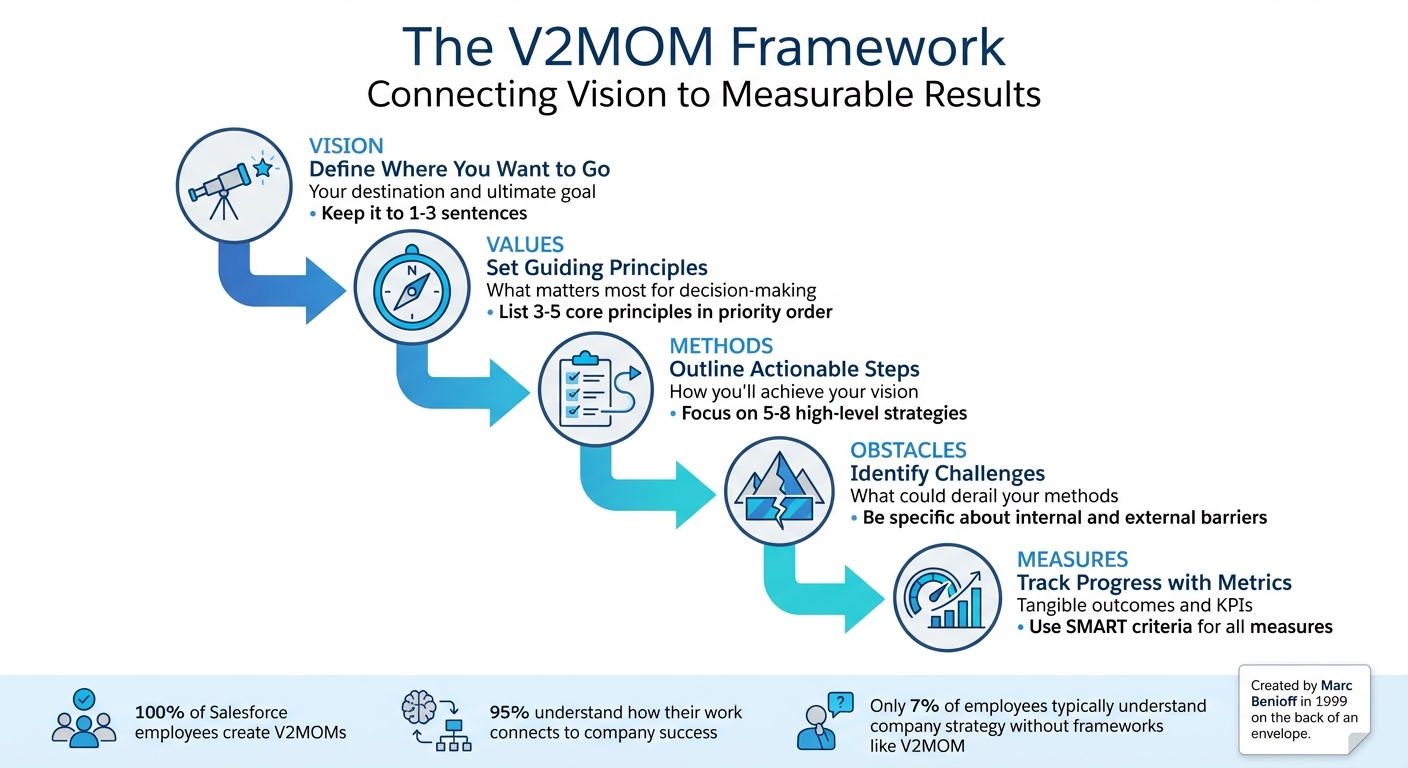
V2MOM Framework: 5 Components for Strategic Alignment
V2MOM: The Salesforce Management Process | Vision, Values, Methods, Obstacles, Measures
How to Write a Vision Statement Using V2MOM
Crafting a vision statement with the V2MOM framework begins with a clear understanding of your organization's ultimate goal. A vision statement isn't about the day-to-day operations - it’s about defining the destination you’re striving to reach. It serves as a guiding star, showing where you want to go.
Before putting pen to paper, take a moment to review your company and manager V2MOMs. This ensures your vision aligns with the broader organizational strategy. Remember, V2MOM is designed to cascade from the top down, so your vision should naturally connect to the company’s overarching goals.
Keep it concise - 1 to 3 sentences is ideal. A great example comes from April 1999, when Marc Benioff and his co-founders sketched Salesforce's first V2MOM on the back of an envelope. Their vision? "Rapidly create a world-class Internet company for Sales Force Automation." This straightforward statement provided a clear direction for the fledgling company.
Avoid including metrics or specific numbers in your vision statement; those belong in the "Measures" section of the V2MOM. Instead, focus on the broader impact you want to achieve - for your employees, customers, and community. Make it forward-thinking and inspiring, but simple enough that everyone on your team can easily understand and remember it. Next, we’ll explore the elements that make a vision truly effective.
What Makes a Good Vision Statement
An effective vision statement has three key attributes: clarity, inspiration, and alignment with your organization’s long-term goals. It should be simple enough for any team member to recall when making decisions, yet impactful enough to guide the entire organization through growth and challenges.
Clarity means using straightforward, memorable language. Avoid vague or overly complex statements that sound impressive but fail to communicate your destination. A strong vision acts as a "North Star", helping your team make decisions that align with your ultimate goal.
"A vision is a picture of a better place. You see this picture in your head: It's what you want the world to look like because your product or team exists."
- Claire Lew, Founder, KnowYourTeam
Inspiration comes from creating a vision that motivates and excites. It’s not about fleeting joy - it’s about instilling a sense of purpose and drive. Leaders often describe this as creating a feeling of "longing bliss", where the work feels meaningful and energizing. Your vision should reflect your team’s unique identity and values.
Alignment ensures your vision connects directly to business goals and can be turned into actionable steps. In the V2MOM framework, your vision feeds into the Values, Methods, Obstacles, and Measures, creating a seamless flow from aspiration to execution.
| Vision Attribute | What It Means | Common Mistake to Avoid |
|---|---|---|
| Clarity | Uses simple, memorable language to guide decision-making | Writing a vision that's too long or vague |
| Inspiration | Drives a sense of purpose and excitement for the team | Copying another company's vision statement |
| Alignment | Links to business goals and cascades through the organization | Developing a vision in isolation without referencing the company V2MOM |
Let’s see how these principles play out in real-world examples.
Vision Statement Examples from Real Companies
Looking at real-world examples can help clarify what makes a vision statement effective. These organizations used the V2MOM framework to create visions that were both actionable and inspiring.
Salesforce offers one of the most well-known examples. Their vision, crafted using V2MOM, focused on the "what" - becoming a world-class company - without diving into the "why" or specific metrics. This clarity gave the team a defined destination while leaving room for the Values and Methods to shape the journey.
"The vision helped us define what we wanted to do."
- Marc Benioff, CEO, Salesforce
NASA provides another iconic example. In 1961, President John F. Kennedy laid out a bold vision: "This nation should commit itself to achieving the goal, before this decade is out, of landing a man on the moon and returning him safely to the earth." This vision unified resources and efforts, culminating in 12 astronauts walking on the moon by the end of the decade.
Other industries adapt their visions to their specific contexts. For instance, a healthcare organization might aim to "Provide high-quality, patient-centered care to improve the health of our community." A banking institution could declare, "Lead the digital revolution in banking and provide unrivaled financial solutions." These statements focus on the "what" and serve as guiding philosophies for the actions to follow.
Across all these examples, a few traits stand out: they are concise, forward-thinking, and easy to understand - qualities that make them memorable and effective for driving organizational focus and alignment.
Connecting Values, Methods, and Obstacles to Your Vision
Linking your vision to the remaining elements of the V2MOM framework - Values, Methods, and Obstacles - is where inspiration meets execution. These components work together to bridge the gap between aspiration and action, ensuring everyone on the team knows not just where you're headed, but also how you'll get there and what challenges might arise along the way.
Start with Values to establish guiding principles, move to Methods to outline actionable steps, and then identify Obstacles that could impede progress. Following this sequence ensures a logical flow: you build on a strong foundation before tackling potential roadblocks. This structured approach helps convert a vision into a clear, actionable plan that every team member can understand and contribute to.
Connecting Your Values to Your Vision
Values are the cornerstone of your vision, providing the principles that guide every decision. They define what matters most and serve as a compass, helping leaders prioritize and avoid distractions that don't align with long-term goals.
Take Salesforce as an example. Their foundational Values - "World-class organization", "Time to market", and "Functional excellence" - shaped decisions around hiring, product development, and strategy.
"The values established what was most important about that vision; it set the principles and beliefs that guided it (in priority)." - Marc Benioff, CEO, Salesforce
List your Values in order of priority, typically focusing on 3 to 5 core principles. This ranking becomes essential when facing trade-offs. For instance, if "Innovation" takes precedence over "Cost efficiency", you'll know which path to follow when those priorities clash. Before finalizing your Values, review the company-wide V2MOM to ensure alignment across all levels of the organization.
With your Values set, the next step is defining Methods to bring them to life.
Choosing Methods to Reach Your Vision
Methods translate your Values into actionable strategies. They answer the critical question: How do we achieve our vision? A well-focused V2MOM typically includes 5 to 8 high-level methods to maintain clarity and avoid spreading your team too thin.
Ensure your Methods align with the organization's overarching goals by cross-referencing the company-wide V2MOM and your manager's V2MOM. Then, identify the initiatives required to achieve your vision, using your Values as a lens. For example, if "Innovation" is a core value, your Methods might include launching specific R&D projects or adopting new technologies.
Salesforce's original V2MOM is a great example of actionable, well-defined Methods.
"The methods illustrated how we would get the job done by outlining the actions and the steps that everyone needed to take." - Marc Benioff, CEO, Salesforce
When crafting your Methods, apply the SMART criteria - ensure they are Specific, Measurable, Achievable, Relevant, and Time-bound. However, avoid including metrics here; those belong in the Measures section. Instead, focus on the strategic actions themselves. List Methods in priority order, placing the most critical initiatives at the top. Finally, share your draft Methods with colleagues to identify overlaps or opportunities for collaboration and to ensure no team’s obstacle is already addressed by another’s method.
Finding and Solving Obstacles
After defining your Methods, it’s time to anticipate and address potential hurdles. Obstacles are the challenges that could derail your Methods. Identifying them early allows you to plan solutions rather than reacting to problems as they arise. Crucially, define Obstacles only after outlining your Methods - this ensures your focus remains on real barriers to execution, not generic business concerns.
Obstacles can be internal or external. Internal challenges might include skill shortages, resistance from leadership, or inadequate training. External obstacles could involve regulatory shifts, competitive pressures, or infrastructure limitations. For instance, in Salesforce's 1999 V2MOM, their Obstacles were specific: they needed developers and product managers. These weren’t vague issues - they were precise gaps that could have jeopardized their Methods.
"The obstacles identified the challenges, problems, and issues we would have to overcome to achieve our vision." - Marc Benioff, CEO, Salesforce
Be as specific as possible when listing Obstacles. Instead of writing "competition", name the competitor or market barrier that poses a threat. Prioritize obstacles by their potential impact - focus on those most likely to hinder your Methods. Conduct a "failure analysis" by asking questions like: What would failure look like? and What’s standing between us and our goals?
Finally, stay focused by rejecting initiatives that don’t directly advance your prioritized goals. This ensures resources are directed toward overcoming the challenges that matter most. The V2MOM framework’s cascading structure allows Obstacles identified at the leadership level to become more detailed as they are addressed by individual teams, enabling tailored solutions across the organization.
Tracking Vision Progress with V2MOM
Measures are the final piece of the V2MOM framework, turning your vision into tangible outcomes. They transform your Methods into measurable results, ensuring accountability at every level of your organization.
Think of Measures as both your roadmap and compass. They tell you where you are, where you're heading, and if you’re veering off track. When Salesforce founders created their first V2MOM in April 1999, they outlined five specific Measures: "Prototype is state-of-the-art", "High-quality functional system", "Partnerships are online and integrated", "Salesforce.com is regarded as a leader and visionary", and "We are all rich." These clear goals helped guide Salesforce from a fledgling startup to a global powerhouse [5][6].
But here’s the thing: the V2MOM isn’t a one-time exercise. Measures should spark ongoing discussions throughout the year, shaping decisions and keeping teams aligned. Research from Harvard’s Robert Kaplan reveals that only 7% of employees fully understand their company’s strategy and what’s expected of them to achieve it [6]. Clear and visible Measures help bridge that gap.
Now, let’s dive into how to set up precise metrics that transform vision into action.
Setting Up Metrics for Success
A great starting point is the SMART framework: every Measure should be Specific, Measurable, Achievable, Realistic, and Time-bound [5].
"The measures specified the actual result we aimed to achieve; often this was defined as a numerical outcome." - Marc Benioff, CEO, Salesforce [5]
Whenever possible, use numbers to make goals concrete. For example, instead of saying, "Improve customer satisfaction", aim for something like, "Increase CSAT score from 78% to 85% by Q3 2026." Numbers provide clarity and give teams a clear target to rally around.
It’s also important to balance your metrics across three categories:
- Lagging KPIs: These reflect past results, like revenue growth or churn rate.
- Leading KPIs: These track ongoing activities, such as Net Promoter Score or social media engagement.
- Counter-KPIs: These act as safeguards, ensuring you don’t over-optimize one area at the expense of another. For instance, if you’re tracking click-through rates, include a counter-KPI for brand reputation to maintain long-term trust.
To ensure alignment, review the company-wide V2MOM and your manager’s V2MOM. At Salesforce, 100% of employees create and publish their own V2MOMs, and 95% report understanding how their work connects to the company’s overall success [7]. This level of clarity comes from disciplined alignment across the organization.
Once your metrics are set, data becomes your tool for continuous improvement.
Using Data to Improve Results
Measures aren’t just for tracking - they’re tools for growth. Regularly reviewing metrics allows you to refine your Methods, reallocate resources, and adjust plans as conditions change.
Incorporate V2MOM reviews into 1-on-1 and quarterly meetings. Use these check-ins to ask questions like: Are our current projects still aligned with our Methods? What adjustments are needed to reflect today’s realities? [7]. This keeps the V2MOM dynamic and relevant, rather than letting it fade into the background.
Transparency is key. Make your Measures visible across the organization. When employees understand how their work ties into the bigger picture, trust grows, and silos break down [6]. At Salesforce, V2MOMs are published internally, so any employee can see what their colleagues - and even their CEO - are working toward. This openness fosters a culture of accountability, where progress becomes a shared responsibility.
Treat your V2MOM as a living document. Plan for quarterly updates and a formal mid-year refresh to ensure your Measures stay aligned with shifting market trends, competitive pressures, and internal priorities [7]. When progress slows, use the Obstacles section to identify barriers and adjust your Methods accordingly.
"The V2MOM is a living, breathing document. And it gets very grumpy if you don't feed it and take care of it regularly." - Salesforce Trailhead [7]
Use your Measures to encourage honest conversations about what’s working, what isn’t, and what needs to change. When employees are aligned through clear goals, their focus and effort can drive meaningful results [6]. It’s all about moving forward.
sbb-itb-ee93501
How V2MOM.io Makes Vision Development Easier
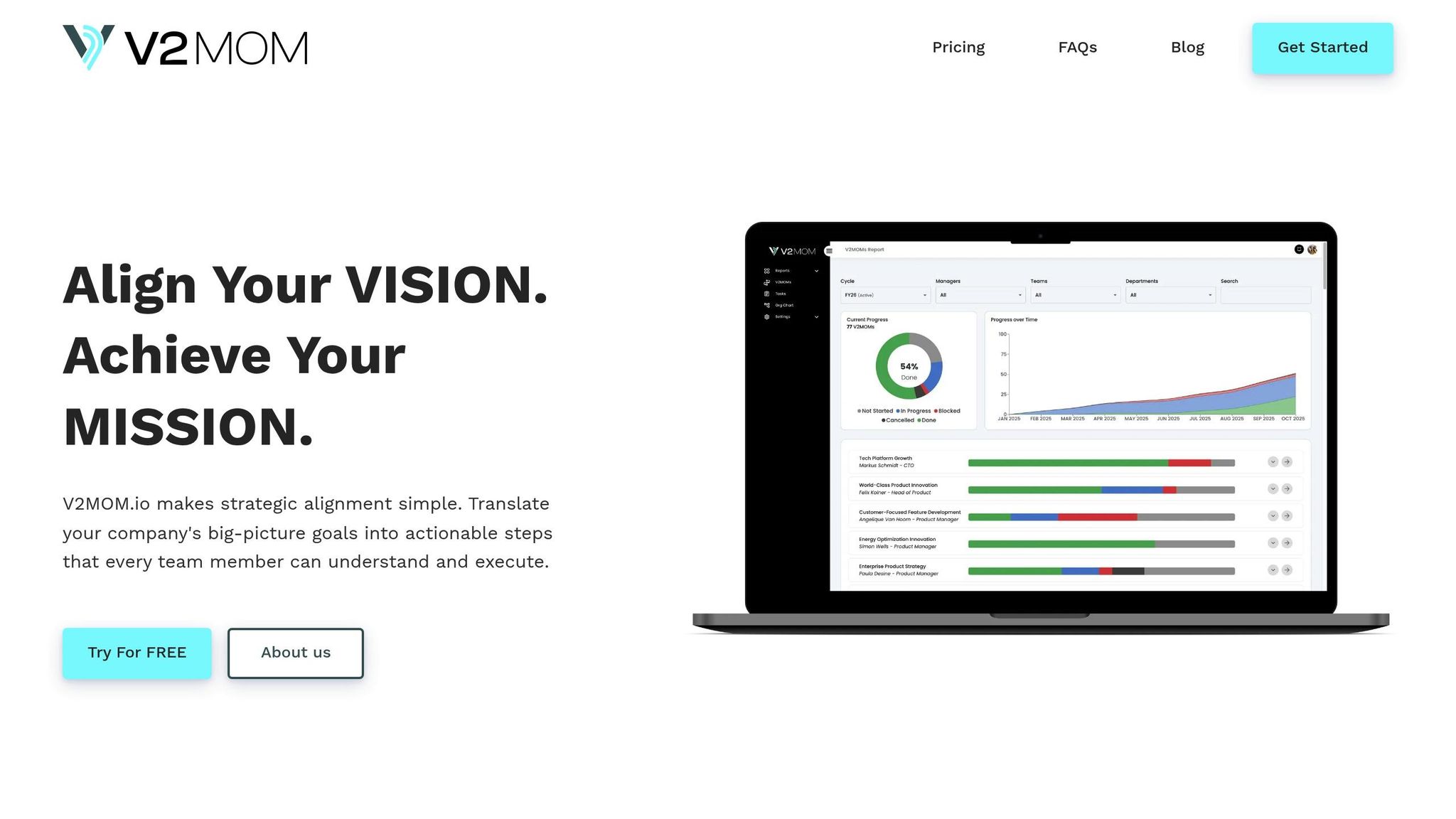
V2MOM.io simplifies the process of creating and maintaining a strategic framework. Let’s face it - building a V2MOM can feel overwhelming when you’re juggling spreadsheets, documents, and a mix of tools. V2MOM.io eliminates that chaos, offering a single platform tailored specifically to the V2MOM framework [2].
A clear vision requires constant alignment, not just annual check-ins that lose relevance over time. V2MOM.io ensures that alignment happens every day by keeping your vision, values, methods, obstacles, and measures front and center for your entire organization.
Centralized Vision and Strategy Tools
With V2MOM.io, all five components - vision, values, methods, obstacles, and measures - are housed in one place. No more digging through folders or jumping between apps to piece your strategy together. Everything lives in a centralized hub, making it easy for everyone to see how their work ties into the bigger picture.
The platform also features customizable KPI dashboards that connect daily metrics to your long-term goals. You can track progress in real time, quickly identifying areas where teams are thriving or need extra help. This level of transparency breaks down silos and encourages better communication across departments.
Beyond just organization, V2MOM.io guides you step-by-step through the framework - from defining your vision to setting actionable measures. This structured flow ensures your strategy moves seamlessly from big-picture ideas to day-to-day execution.
Real-Time Progress Tracking and Team Collaboration
V2MOM.io transforms your framework into a dynamic, living document. Real-time tracking and collaboration tools allow teams to update their progress, share feedback, and shift priorities as needed - no waiting for quarterly reviews. Considering that only 7% of employees fully understand their company’s strategy [6], these features ensure everyone knows their role and how their efforts contribute to the organization’s success.
The platform’s visualization tools and KPI dashboards make it easy to spot trends and address challenges before they escalate. By making each team’s V2MOM accessible across the organization, it fosters accountability and encourages cross-functional collaboration. This real-time alignment helps businesses stay agile and scalable, no matter their size.
Flexible Options for Businesses of All Sizes
Whether you’re running a small startup or managing a large enterprise, V2MOM.io adapts to fit your needs. The platform supports cascading alignment, meaning you can apply the framework at every level - corporate, departmental, team, and individual.
For smaller teams, the free Starter plan (up to 10 users and 3 teams) offers essential tools to centralize vision, monitor progress, and encourage collaboration. Growing businesses can opt for the Business plan at $5.99 per user/month (billed annually), which includes advanced features for scaling efforts. From aligning new hires with company values to presenting a strategic roadmap to investors, V2MOM.io has you covered.
The platform also allows for team-specific customization, making it easy to adapt to dynamic groups or unique organizational structures. You can even integrate other frameworks like SMART goals or OKRs into your Methods and Measures sections, ensuring the system complements your existing workflows.
"A long-term, clearly articulated vision serves as the 'North Star' when it comes to plotting a course or making a decision." - David Ciccarelli, CEO, Voices [2]
Built with simplicity in mind, V2MOM.io is designed for the people who actually use it. Updates take just minutes, keeping the process efficient and stress-free while ensuring your strategy stays on track.
Common Vision Development Mistakes and How to Avoid Them
Even seasoned leaders can misstep when crafting their V2MOM. A common error is packing the vision with excessive details. When a vision becomes too detailed, it loses clarity and immediacy. Another mistake is placing quantified objectives in the Vision section, where they don't belong. Those should go in the Measures section instead [1]. The vision should focus on the "what" and the ideal outcomes, leaving specific metrics to track progress separately. Additionally, listing too many methods can dilute efforts, spreading resources too thin and reducing the likelihood of success [5].
Another issue is failing to prioritize effectively. As IT Transformation Consultant Mark Edmead succinctly states:
"If every value is a priority then nothing is" [4]
Prioritizing values, methods, and obstacles ensures your team remains focused and avoids wasting energy on less critical tasks [4]. Here’s a closer look at these common pitfalls and how to steer clear of them.
Making the Vision Too Complicated
One of the most frequent missteps is overcomplicating the vision. Keep it simple and concise - ideally, it should fit on one page. David Ciccarelli, CEO of Voices, explains:
"One of the first challenges is crystallizing a vision into a few sentences... This is important because it is the executive team's responsibility to be constantly communicating the vision and values" [2]
If your vision takes too long to explain, it won’t serve as the clear "North Star" your organization needs.
Use bold, inspiring, and straightforward language. Avoid jargon or corporate buzzwords that sound impressive but lack real meaning. A great vision is memorable and easy for employees to recall when making daily decisions. To maintain clarity without overcomplicating, apply the SMART model (Specific, Measurable, Achievable, Relevant, Time-bound) when defining your methods and measures.
Poor Communication of the Vision
Marc Benioff, CEO of Salesforce, highlights the importance of communication:
"While a company is growing fast, there is nothing more important than constant communication and complete alignment" [5]
Yet, only 7% of employees fully understand their company's business strategies and their role within them [6].
This gap can be bridged with radical transparency. Make your V2MOM accessible to everyone in the organization so employees can see leadership priorities and understand how their work aligns with company goals. Centralized and open communication not only builds trust but also encourages collaboration. Think of your V2MOM as a living document that sparks ongoing conversations between managers and employees about priorities and resource allocation.
Skipping Regular Updates and Reviews
Your V2MOM isn’t a one-and-done document. As market conditions change and priorities shift, neglecting regular updates can render it obsolete. Schedule annual reviews to refresh the vision and ensure it continues to inspire and guide your team [5].
Frequent discussions about V2MOM progress are key. Managers and employees should review what’s working, adjust strategies as needed, and track measures in real time to address issues before they escalate. Keeping the V2MOM visible - whether printed in a shared space or hosted on a centralized platform - helps maintain its relevance. When major changes occur, such as a market pivot or new opportunities, revisit the entire V2MOM instead of trying to force outdated plans to work [3][6].
Conclusion: Achieving Alignment with V2MOM
The V2MOM framework bridges the gap between strategy and execution. By following its sequence - Vision, Values, Methods, Obstacles, and Measures - leaders can chart a direct course from big-picture goals to daily tasks. This approach ensures that every team member knows their role, understands its importance, and sees how it contributes to the broader success of the organization.
What makes this framework so effective is its straightforward and transparent design. Take Salesforce as an example: they use V2MOM to align over 75,000 employees. This shows how the framework can scale seamlessly, whether you're running a startup or a global enterprise. When everyone has visibility into the V2MOM framework, engagement and accountability naturally follow. This clarity not only brings teams together but also sets the stage for meaningful progress.
Why Choose V2MOM.io?
V2MOM.io simplifies strategic planning by integrating everything - Vision, Values, Methods, Obstacles, and Measures - into one cohesive platform. Instead of juggling multiple tools, leaders have a single source of truth for their strategy.
The platform's real-time progress tracking helps leaders spot and address potential roadblocks before they grow. Built-in collaboration tools reduce the need for endless meetings, keeping teams focused and aligned. Plus, the cascading feature allows leaders to break down overarching goals into actionable V2MOMs for teams and individuals, ensuring alignment at every level. With this setup, moving from planning to action becomes seamless.
Steps to Get Started
Start by collaborating with your leadership team to create a company-wide V2MOM. Keep it concise - aim for a single page that clearly defines your vision and the values that drive it. Use SMART criteria to make your methods and measures specific, actionable, and trackable. Share drafts with your team to turn obstacles into opportunities for collective problem-solving.
Think of your V2MOM as a dynamic document. Schedule quarterly reviews to evaluate progress and update it annually as market conditions change. This adaptable approach ensures that every team member not only understands the vision but also acts on it consistently. To make the process even easier, try V2MOM.io's free Starter plan, which supports up to 10 users and 3 teams. It’s a great way to test the framework before scaling it to fit your organization's needs.
Clarity is the foundation of alignment. V2MOM gives you the framework, and V2MOM.io equips you with the tools to bring it to life every day.
FAQs
How does the V2MOM framework help align teams within an organization?
The V2MOM framework takes a company’s strategy and turns it into a clear, actionable plan that everyone can get behind. It breaks things down into five essential elements: Vision, Values, Methods, Obstacles, and Measures. This structure ensures that every team member knows exactly what the organization is aiming for, why it’s important, how the goals will be achieved, what challenges might arise, and how success will be tracked. By providing this clarity, the framework helps align daily tasks with the company’s bigger objectives, creating a sense of purpose and teamwork across the board.
V2MOM.io takes this framework to the next level by offering a platform where teams can create, share, and track their V2MOM in real time. Everything is centralized in one workspace, making collaboration easier and progress more transparent. The platform also includes tools to monitor performance and spot potential misalignments early. By turning the framework into a practical, interactive tool, V2MOM.io helps businesses stay on track and focused on what truly matters.
How do you create a strong vision statement using the V2MOM framework?
Creating a strong vision statement is a crucial step in the V2MOM framework. It sets the tone and direction for your organization, acting as a beacon for your team to follow. A well-crafted vision statement paints a clear and inspiring picture of the future you’re striving to create. Here’s how you can craft one effectively:
- Define your end goal: Focus on the destination, not the journey. Ask yourself, "What do we want to achieve?" Keep the statement concise, aiming for something that feels both ambitious and attainable.
- Align with your core values: Make sure your vision reflects the principles your organization stands for. This alignment not only builds trust but also reinforces a sense of shared purpose.
- Collaborate with key players: Bring leadership and essential team members into the process. Their perspectives can provide valuable insights and help ensure everyone is on the same page.
- Keep it straightforward: Avoid jargon and overly complex language. The best visions are easy to understand and tied to clear, measurable outcomes.
Once you’ve nailed down your vision, make sure to document it in V2MOM.io. Centralizing it alongside your strategic plan ensures it stays front and center, guiding your team as you track progress and work toward your goals.
How does V2MOM.io help teams track strategies and collaborate in real time?
V2MOM.io takes the Vision, Values, Methods, Obstacles, and Measures framework and turns it into an interactive, cloud-based workspace. It centralizes all these elements, making them accessible to your entire team in real time. As team members update Methods or add new Measures, dashboards refresh instantly - eliminating the need for manual reporting and giving leaders a clear view of progress at any moment.
The platform includes handy tools like notifications and commenting, making it easy for teams to flag obstacles, propose updates, and approve changes right away. This transforms strategy tracking into a continuous, collaborative effort. With real-time data updates and visual progress indicators, managers can quickly spot bottlenecks, shift priorities, and ensure everyone stays aligned with shared objectives.
Additionally, V2MOM.io leverages data-driven insights by pulling the latest results into analytical views. This allows teams to track trends and measure performance against goals, ensuring focus remains on actions that truly drive results and keep your vision moving forward.